
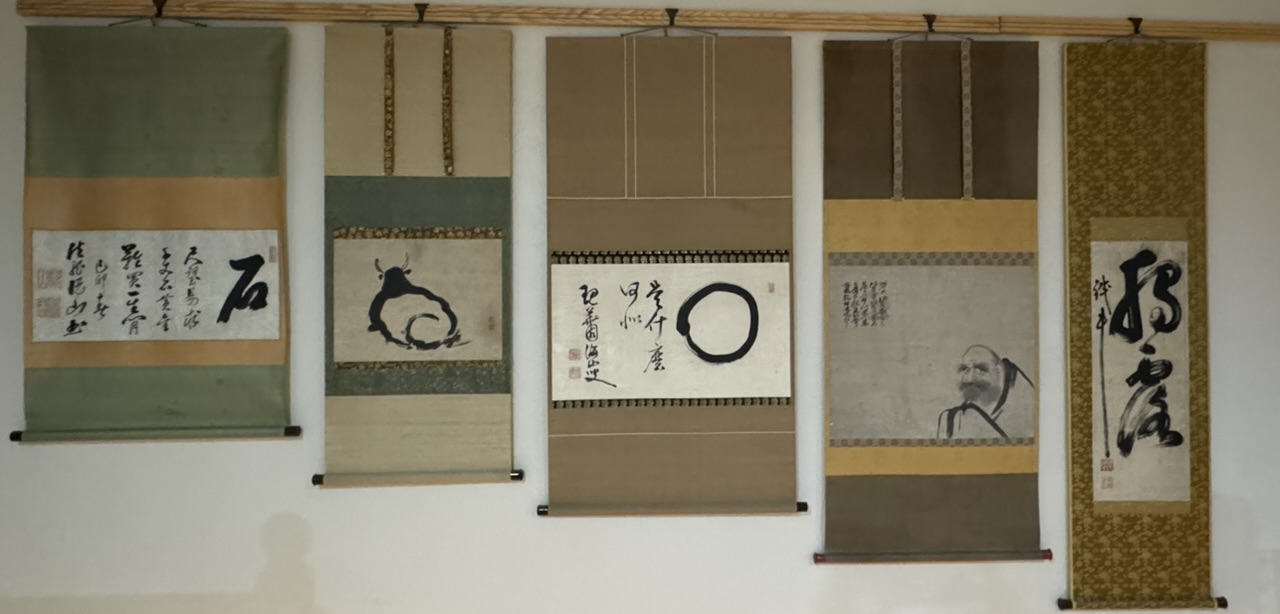

Zen Bull
Kogan Gengei (1748-1821) was the abbot of Kogen-ji temple in Tamba and a disciple of Hakuin Ekaku and Suio Genro. A bull fears nothing, and when he sits, he really sits; when he moves, he really moves–the ideal behavior of a Zen adept. A bull additionally stands for the mind; uncontrollably wild at first, but capable of being tamed, harnessed, and eventually set free to roam contentedly wherever it pleases. The bull appears to be formed from an Enso.
Provenance, Zen Art Gallery (Belinda Sweet). Personal collection.

As the Fragrant Breeze Comes from the South (薫風自南来)
Oki Sogen (大森 曹玄) was the third abbot of Ryōbozen-an, a sub-temple within the Myōshin-ji school of the Rinzai sect of Zen Buddhism. The temple’s formal name includes the mountain name Garyūzan. Myōshin-ji, located in Kyoto, Japan, is the head temple for the largest branch of Rinzai Zen Buddhism, with over 3,000 affiliated temples.
The inscription is a famous line from an account of the enlightenment experience of Dahui Zonggao (大慧宗杲, 1089–1163) in an encounter with his master Yuanwu Keqin, which also serves as a Zen koan1,2:
“Master Yuanwu ascended the high seat in the lecture hall at the request of Madame Chang K’ang-kuo (張康國夫人). He said, “Once a monk asked Yunmen this question, ‘Where do all the Buddhas come from?’ Yunmen answered. ‘The East Mountain walks on the water’ (Tung-shan shuei sheng hsing).3 But if I were him, I would have given a different answer. ‘Where do all the Buddhas come from (諸佛皆出自何處)? As the fragrant breeze comes from the south, a slight coolness naturally stirs in the palace pavilion (薫風自南来).’ When I heard this, all of a sudden there was no more before and after. Time stopped. I ceased to feel any disturbance in my mind, and remained in a state of utter calmness.”
Yuanwu was quoting the conclusion verse from a poetry contest in which Emperor Wenzong of the Tang dynasty wrote an introduction verse stating, “Others suffer from the scorching heat, but I love the long summer days (別人受酷暑之苦,我愛夏日長日).” The poet Liu Gongquan then composed the conclusion verse, which Yuanwu quotes as his preferred answer to “Where do all te Buddhas come from?.”
The story highlights the Zen principle that enlightenment is not found through intellectual study or dogmatic answers, but through direct, immediate experience of the self-evident nature of truth. Just as one doesn’t need to be told a southern breeze is cool, the reality of the Dharma is something to be directly experienced, not intellectually understood through words or concepts. We live our lives obsessed with gain and loss, caught up in self-interest, biased toward love and hate, and right and wrong, and we are driven back and forth by the dichotomous biases of the discriminating mind. Koan study is intended to induce the “Great Death,” which severs us from this duality.
1Chun-Fang Yu, “Ta-hui Tsung-kao and Kung-an Ch’an.” Journal of Chinese Philosophy V. 6 (1979) pp. 211-235
2Case 92 in “Entangling Vines: A Classic Collection of Zen Koans” (2013)
3Ibid, Case 49

Enso
Kaisan Sokaku (1768-1846) was the Dharma heir of Takuju Kosen (1760-1833), who was himself a major disciple of Hakuin Ekaku (1686-1769). Enso—the iconic and celebrated “circle” brushed by Zen Masters—often interpreted as a representation of both the void and the universe, emptiness and fullness, the one and the all. One traditional inscription for Enso paintings is “What is it (Kore nan zo 是什麼)?” such as the more contemporary Enso (bottom) by Hosoai Katsudo, Chief priest of Daitoku-ji Ryugen-in. Instead, Kaizan asks, “Why (ask) ‘why is it?’” (為什麼, 何以?).”
These Enso are a reference to a koan from the Blue Cliff Record (Case 51, Hsueh Feng’s “What is it?”). The “it” and “the last word” reference enlightenment or the awakened mind (“True Self”), but what they actually are can only be experienced directly, not explained with “words or letters.” This long koan also emphasizes the way that, through friendship, we can propel one another on the spiritual journey even as the path it takes may differ:
“When Hsueh Feng was living in a hut, there were two monks who came to pay their respects. Seeing them coming, he pushed open the door of the hut with his hand, popped out, and said, “What is it?” A monk also said, “What is it?” Feng lowered his head and went back inside the hut.
Later the monk came to Yen T’ou. T’ou asked, “Where are you coming from?” The monk said, “I’ve come from Ling Nan.” T’ou said, “Did you ever go to Hsueh Feng?” The monk said, “I went there.” T’ou said, “What did he have to say?” The monk recounted the preceding story. T’ou said, “What did he say?” The monk said, “He said nothing; he lowered his head and went back inside the hut.” T’ou said, “Alas! It’s too bad I didn’t tell him the last word before; if I had told him, no one on earth could cope with old Hsueh.”
At the end of the summer the monk again brought up the preceding story to ask for instruction. T’ou said, “Why didn’t you ask earlier?” The monk said, “I didn’t dare to be casual.” T’ou said, “Though Hsueh Feng is born of the same lineage as me, he doesn’t die in the same lineage as me. If you want to know the last word, just this is it.”


Daruma
Poem translation (Okabe Hisashi, “400 Years of Zen Painting”):
The sound of roaring, terrifying Heaven and Earth
Pitifully, the hundred beasts all run away in fright
Suddenly, he strikes and breaks the front teeth;
Despite all persecutions, he prevails.
Fugai Ekun (1568-1654). In 1616 he became the Soto Zen abbot of Joganji in Sagami Province (now part of Kanagawa Prefect), but after only a few years he gave up his position to live in caves of the Kamisoga Mountains, which earned him the nickname 「穴風外」Ana Fūgai (“Cave Fūgai“).
“The paintings of Fūgai Ekun, simply brushed with ink on paper, convey a depth of spirit that makes them unique even within the sphere of Zen art. His works are imbued with a haunting intensity; the eyes of the figures he depicts penetrate deep into the human spirit, providing the viewer with a sense of direct communication with the artist. Yet Fūgai never received the recognition that other Zen artists have been given, in large part because he lived far away from the major cultural centers, had no pupils, and founded no school. Historically, Fūgai was the first and most important Zen monk-painter of the Sōtō sect. Fūgai also anticipated future directions in Zenga by inscribing his own poems on his paintings and by brushing informal self portraits. His final years were spent in nomadic travel; he died almost literally ‘on the road’.” 1
Provenance, Zen Art Gallery (Belinda Sweet). Personal collection.
1The Art of Zen: paintings and calligraphy by Japanese monks 1600-1925. Stephen Addiss; publisher Harry N. Abrams, Inc., New York (1989); pg. 44-58
(https://terebess.hu/zen/fugai/FugaiEkun.html).
The Body Contains the Universe (體內貯乾坤)


Etsuzan Dōshū (1629-1709, Yueshan Daozong 悦山道宗) brushes the vertical line 體內貯乾坤 ("the body containes the universe") in large characters, which echoes a Zen teaching contained in the koan Case #69 in The Blue-Cliff Records called "Yunmen's Jewel." Master Yunmen Wenyan (c. 864–949) said, "Within heaven and earth, throughout the universe, there is a single jewel, hidden inside the mountain of form."

To understand the Taoist influence and the Zen interpretation of this phrase, we must examine both the literal and conceptual meaning1:

體內 (tǐ nèi): Inside the body, within the body.
貯 (zhù): To store, to hold, to contain.
乾坤 (qián kūn): This is the key term.
Literally, it means "Heaven and Earth," "the cosmos," or "the universe." In the I Ching (Book of Changes), Qián is the creative, heavenly force, and Kūn is the receptive, earthly force. Together, they represent the totality of existence, all of reality, the entire dynamic interplay of yin and yang.
So, a very literal translation is: "The body contains the universe."

While the phrase uses Daoist terminology (乾坤), Zen Buddhism adopts and transforms such ideas to point to its own core insights. The literal meaning is just the starting point. In a Zen context, this phrase points to several profound realizations:

1. The Non-Duality of Self and World
Zen teaches that the fundamental assumption that we are a separate "self" inside a body, looking out at an external world, is an illusion. The boundary we draw between "inside" and "outside" is a mental construction.

"體內貯乾坤" smashes this boundary. It means that the entire cosmos is not something you are in; it is something you are. The mountains, the rivers, the stars, the sounds, the silence—all of it is your very body. There is no inside and outside, only one unified field of being.

2. The Microcosm as the Macrocosm
This is a classic idea in both Eastern thought and, more recently, in Western philosophy (like in William Blake's "To see a world in a grain of sand").

The human body is not a small, isolated object. It is a perfect reflection and embodiment of the entire universe. The same laws of physics, the same elements forged in stars, the same cycles of nature (birth, growth, decay) that govern the cosmos are all happening within your own physical form. You are the universe experiencing itself in a localized way.

3. The Body as a Vessel for Awakening
In Zen practice, the body is not disregarded. It is the very vehicle for enlightenment. Through meditation (zazen), we come to realize that our true nature is not limited by the skin. The sensation of the body expands to include the entire universe. The breath is not just air moving in and out of lungs, but the very interchange with the totality of the atmosphere. The body becomes a vessel that "stores" or, more accurately, is the dynamic, living cosmos.

In summary, in Zen, "體內貯乾坤" is not a statement of biology or physics, but a declaration of spiritual realization. It points to the awakened experience of non-duality, where the individual body is understood to be inseparable from the totality of existence. It is an invitation to stop seeing yourself as a tiny part of the universe and to realize that the entire universe is your true body. And the true body contains the Buddha-nature.

While the exact wording "體內貯乾坤" brushed on Etsuzan's scroll isn't in the existing records of Master Yunmen's teachings, its essence is not only present but is a fundamental pillar of his Zen. It is most clearly articulated through his famous principles: "函蓋乾坤" (the universe is completely enveloped by the true self) and the teaching of the jewel hidden "秘在形山" (within the mountain of the body).2

Signature: Obaku Yueshan sho 黃檗悦山書
Seals: 臨済正宗三十四世, Rinzai shoshu sanju-yon sei (34th generation heir of the transmission of the Linji/Rinzai Sect); 悅山, Etsuzan; 道宗之印, Doshu no in (Doshu's seal, )

Provenance: John P. Coolidge Collection (former director of the Fogg Art Museum at Harvard University, 1948 - 1971); The Coolidge Cost Collection (by descent)

Exhibited:
Fogg Art Museum, Harvard University, Cambridge, Massachusetts

1Deep Seek answer to query: "What does 體內貯乾坤 mean in Zen?"
2Deep Seek answer to query: "Does 體內貯乾坤 appear in the writings of Master Yunmen?"
Enso

Nakahara Nantenbo (1839-1925), whose Buddhist name was Toju Zenchu (Complete Devotion), was in the last 17 years of his life the Exalted Master of the main temple of Moyoshin-ji of the Rinzai sect. A contemporary of the great lay Zen master, swordsman, calligrapher/artist, and statesman Yamaoka Tesshu, whom he met while teaching at the training hall at Sokei-ji in Tokyo and had daily private meetings with, he was a tireless reformer of Zen monastic training and activity, emphasizing strict practice and koan study.
Done when he was 80 years old (1920), this delightful Enso shows Nantenbo’s sense of humor even while encouraging the pursuit of enlightenment. The moon is a more concrete manifestation of the Enso in the empiric world, symbolizing sudden enlightenment. However, he also challenges us to make a diligent, single-minded, and bold effort to seize the opportunity for achieving self-evident truth when it presents itself. Tsuki (moon) appears in kanji as 月. The structure is not quite haiku.
If that moon falls,
I will give it to you,
Now try to take it.

kono tsuki ga, (この 月 が)
hoshiku bayarou (ほしくば やろ)
tote miyo (とて みよ)

Similar to the example from the "Art of Zen" exhibit at the National Gallery of Victoria, 2004.
Boat at Sunset

Sesson Shūkei (雪村周継 1504-1589) was a Muromachi Period Soto Zen monk and self-taught artist who is considered the most distinguished and individualistic talent among the numerous painters who worked in the style of Sesshū, the 15th-century artist considered the greatest of the Japanese suiboku-ga (“water-ink”) painters. The two are referred to as "Sesshū of the west, Sesson of the east". He studied the paintings of Shūbun (a suiboku-ga artist active in the first half of the 15th century) and later, from 1533, those of Sesshū and called himself Sesson Shūkei in tribute to the two masters. He worked in a dramatic style that generally accentuated idiosyncrasy, humor, and exaggeration in his approach to subjects, whether figural or landscape. This sansuiga (ink landscape painting) work is an excellent example of his almost calligraphic brushwork style. The boatmen are depicted in a sunset scene, but the foreground is indistinct, abstract, a bit ominous, and filled with yugen (mystery)--more imaginary than rooted in the natural world. He juxtaposes heavy black ink and different shades of grey wash. Although unsigned (mumei), the seal in this work appears to be the same as seen on several of his other works including one on the upper left corner of "Mynah Birds Attacking an Owl" (The Metropolitan Museum), which is also mumei.

Enso


Here Chūhō Sōu (宙宝宗宇, 1759-1838) signs as Shōgetsu rōsō (松月老僧), meaning “Old priest ‘Moonlight on the Pine Trees.’” The colophon that appears at the bottom is found on some of his brush works and crafts such as tea scoops. Together with his characteristic seal 宙宝 (Chūhō), this work is confirmed to be authentic.
Stone
Poem translation: “Small pebbles can build a great wall; purchase this kind of gold all life long!”
Etsuzan Dōshū (1629-1709) was born in China as Yueshan Daozong (悅山道宗). He came to Japan in 1657 to study with Mokuan. In 1705, six years after he produced this calligraphy, he became the seventh abbot of Manpukuji temple of the Chinese Obaku sect of Zen buddhism near Kyoto. Regarded as one of the finest of the Obaku calligraphers and respected as Sho no Etsuzan (Etsuzan of calligraphy). He frequently started his poems with a dramatic large kanji character, the so-called “one character gateway” or “one-word barrier” (ichikan) often employed in Obaku calligraphy.

Hanzan and Jittoku

Tengen Chiben (1737-1805), whose art name was Gako (meaning “Goose Lake”), was a second generation Rinzai monk in the Hakuin Ekaku tradition. He lived and taught at temples like Onsenji and Nanzenji, leaving behind influential ink paintings and calligraphy that showcased his deep understanding of Zen Buddhism. He was known for his expressive figural paintings, especially of Zen eccentrics like Kanzan (Chinese Hanshan 寒山, “Cold Mountain”) and Jittoku (Chinese Shih-te, “Pickup”), following the tradition of Hakuin’s lineage. However, this painting and accompanying inscription of the first two verses of one of Hanshan’s most famous poetic quatrains (#5), shows his lively and individualistic brushwork. The dark outline of their bodies, eyes, and handle of broom stick that stand out from the gray-wash of their clothes, serve as a compositional device to emphasize attention on the moon above. Kanzan and Jittoku were Tao/Buddhist mountain sage-poets living on the fringe of an established monastery during the early development of Ch’an practice, but their poems evidenced their mastery of the Ch’an insight that we are in our inherent nature already enlightened. Jittoku is always shown with a broom that he used as a humble kitchen worker at Guoqing Temple. Interestingly, Gako substitutes the less formal Wǒ (我) for the first character Wú (吾) in Hanshan’s poem, both of which have the same meaning. The verses connect the moon’s perfect, untainted reflection to the enlightened mind (Buddha-mind or kensho), representing clarity, emptiness (mu), and the universe:
吾心似秋月 (Wú xīn sì qiū yuè) - My mind is like the autumn moon,
碧潭清皎潔 (Bì tán qīng jiǎo jié) - clear and bright in a pool of jade,
無物堪比倫 (Wú wù kān bǐ lún) - nothing can compare,
教我如何説 (Jiào wǒ rú hé shuō) - what more can I say1
This particular piece was purchased in auction for a mere fraction of its real value, perhaps unrecognized as the very example from a private collection that was published in Stephen Addiss’ seminal book.2
Another example of this same composition (below left) by Sui Genro ((遂翁元盧, 1717-1790), a disciple of Hakuin, shows his master’s influence.3 Here Jittoku, who worked in the monastery kitchen is shown with his broom. Hanshan is shown with his bamboo water container, accompanied by another Hanshan poem. In some renderings, only the objects are painted to represent these two well-known characters.

Another example by the Obaku monk Baisao (Gekkai Gensho; 1615-1763) of the entire poem is shown below.4

1The Collected Songs of Cold Mountain. Translated by Red Pine; publisher Copper Canyon Press, Washington (2000), pg. 39
2The Art of Zen: paintings and calligraphy by Japanese monks 1600-1925. Stephen Addiss; publisher Harry N. Abrams, Inc., New York (1989), pg. 144 (plate 78)
3Sui Genro Zen Paintings: works from the Jozan Bunko and Eimei-ji temple collection. Japanese language (2011), pg. 26
4The Three Perfections: Japanese Poetry, Calligraphy, and Painting, The Mary and Cheney Cowles collection. John T. Carpenter. The Metropolitan Museum of Art, New York, 2025, pg. 204 (plate 73)
A Different World Inside (壺中)
Chūhō Sōu (宙宝宗宇, 1759-1838) was the 418th chief priest of Daitokuji Temple in Kyoto. His Buddhist name was Chūhō, his given name was Sou, and he was known as Shogetsu (昇月), which means “Rising Moon.” He trained under Sokudo Soki, the 406th bishop of Daitokuji Temple and was a highly revered Japanese Zen master, calligrapher, potter, and tea connoisseur. Chūhō admired and was influenced by his contemporary Jiun Onko. Two works below are excellent examples of his unique style and deep comprehension of the Zen aesthetic and the enlightened mind.

In his usual powerful hand, Chūhō has brushed 壺中 (right to left), practically reinventing the first character. This phrase translates most directly as "Inside the Jar" or "In the Pot."  However, the meaning runs deeper than the literal translation. In Zen and ancient Chinese lore, 壺中 (kochū) carries the connotation of "a different world within," "a microcosm," or "a reality outside of normal time and space." This meaning comes from the legendary Chinese tale of the "Jar Gourd Heaven" (壶天). In this story, a man follows an immortal into a small gourd and discovers a vast, magical palace inside—a complete world within.

Therefore, 壺中 often implies a state of enlightenment where the vast universe is contained in a single object, or where the duality generated by distinctions between inside and outside, large and small, cease to exist. It evokes the Zen principle of "the infinite in the finite."

壺中 is the start of the prefaratory seal of the second work below, suggesting that he identified deeply with this symbol of enlightenment.

Signature: 禅大徳宙宝宗宇書, Zen Daitoku Chūhō Sōu sho (Calligraphy of the former Daitoku priest Shōgetsu)
A Good Thing is Not as Good as No Thing (好事不如無)

Zhaozhou Congshen (趙州從諗, 778–897) is associated with the Guanyin Temple in Zhaozhou during the Tang Dynasty (also known as the East Temple) is now the Bailin Temple in Zhaoxian County, Hebei Province, and was the fourth-generation successor of the Sixth Patriarch Huineng. He was from Caozhou (present-day Heze, Shandong), though another account places him in Linzi, Qingzhou (present-day east of Zibo, Shandong). His secular surname was Hao, and his Dharma name was Congshen. He became a monk at Hutong Temple in Caozhou in his youth, while another account places him at Longxing Temple in Qingzhou.

Selecting from unusual subject matter that seems quite typical of Chūhō, he brushes a line 好事不如無 that comes from an early Ch'an story of an encounter between Ch'an Master Zhaozhou Congshen and his disciple Wenyuan (文遠), which is widely cited in modern and medieval-period Zen and Ch'an commentaries, but has no definitive classical source:

One day, the Master Zhaozhou saw his disciple Wenyuan bowing to a statue of the Buddha. Zhaozhou walked over and struck him with his staff.
Zhaozhou: "What are you doing?"
Wenyuan: "I am paying homage to the Buddha!"
Zhaozhou: "Is the Buddha someone to be paid homage to?"
Wenyuan: "Paying homage to the Buddha is a good thing (好事) ."
Zhaozhou: "好事不如無 (A good thing is not as good as no thing)."

The last phrase originates from the 增廣賢文 (Augmented Collection of Wise Sayings), a popular Chinese didactic text from the Ming Dynasty that is based on a Taoist principle of "福禍相依" (fortune and misfortune depend on each other):

庭前生瑞草, 好事不如無 (Tíng qián shēng ruì cǎo, hǎo shì bù rú wú)
When auspicious grass grows in front of the court, a good thing is not as good as nothing

In Zhaozhou's hands, 好事不如無 becomes "A good thing is not as good as no thing." This is a powerful lesson on non-attachment, a core principle in Zen/Ch'an.  The horizontal strokes in the 2nd and 5th characters anchor the contrasting halves that are separated by 不.
1) Non-Attachment: Even the act of doing a "good thing" (like bowing to Buddha or giving charity) can become a spiritual obstacle if you cling to the identity of being a "good person" or if you do it to gain merit. The Master is teaching that the state of "nothing" (無) or "no thing" is higher than the state of doing "good things" with a grasping mind.
2) The Trap of Intent: The teaching warns against performing good deeds with a "seeking" mind—doing them for the sake of reward, merit, or to bolster one's ego as a "good practitioner." Zhaozhou uses this sudden, shocking action (striking Wenyan) to jolt Wenyan out of this conceptual trap
3) Beyond Duality: Where there is "good," there is "bad." The phrase encourages the practitioner to move beyond this dualistic thinking into the true nature of emptiness, where there is no need to cling to the label of "good" or "bad."
4) "No Thing" (無) as True Peace: The phrase "好事不如無" points to a state of "no-thing-ness" or wu shi (無事). This doesn't mean doing nothing, but rather acting without attachment, without a self-conscious focus on the doer or the deed. It is the state of natural, effortless action that flows from an empty and peaceful mind.

Although the Zhaozhou version of the story does not appear in a classical Ch'an source, 好事不如無 is found in two koan from primary sources that record the sangha encounters of different Ch'an masters:

1) In the koan called "Cloud-Gate's (Yunmen's) Kitchen. Granary. Three Gates" (Case 86, Blue-Cliff Record), there is a clear and direct reference to Zhaozhou's exchange with Wenyuan. David Hinton's lively translation provides a different texture to the meaning of this phrase, which is actually a so-called capping phrase1:

Teaching the assembled sangha, Cloud-Gate Mountain said, "Radiant enlightenment abides within each and every one of you. Those who look without seeing are dark within shadowy dark. How do you reveal this radiant enlightenment that everyone possesses?"
Answering for the sangha, he said, "Kitchen. Granary. Three Gates." [capping phrase 1]
He paused, and then continued, "Our grand and wondrous affairs can't compare with the Absence of simply doing nothing." [capping phrase 2]

2) In Volume 16 of the Jingde Chuándēng Lù (Transmission of the Lamp), initially compiled in 1004, Master Xuěfēng Yìcún (雪峰義存, 822–908) has an encounter with a monk2:

Monk: "Having shaved one's head, dyed one's clothes, and received the Buddha's refuge, why is one not allowed to recognize the Buddha?"
Master Xuěfēng Yìcún: "A good thing is not as good as no thing."

Signature: 禅大徳宙宝宗宇書, Zen Daitoku Chūhō Sōu sho (Calligraphy of the former Daitoku priest Shōgetsu)
Seals: 壺中日月長, kochu nichigetsu nagashi (in "a different world within," the days and months are long); 宙宝, Chūhō; possibly 破水の感, Hasui no Kan (the sensation of the water breaking)

1David Hinton, The Blue-Cliff Record, Shambala Publications, Inc (2024), pg. 172
2Daoyuan Shi (translated by Xingyong Lu), The Jingde Record of the Transmission of the Lamp, Volume 16 to Volume 22, 2026, pg. 10

Water That Comes With Rain Creates Ripples (帶雨水生紋)
Jifei Ruhi (即非如一, 1616–1671), known in Japan as Sokuhi Nyoitsu, was a Chinese Obaku (Huangbo) sect monk and student of Ingen Ryuki and Mokuan Shoto. Together they were known as the “Three Brushes of Ōbaku” or Obaku no Sanpitsu, although each has a distinct style. Like the literal translation of the inscription, Sokuhi’s brushwork glides smoothly like water down the page, as if executed with a single stroke. It’s likely he loaded his brush and used the “hidden-tip” technique of his teacher Ingen to mask the reentry of his brush. This is a masterpiece that embodies the energy of his cursive script, a combination of firm control and swift execution, as evidenced by the lingering presence of “flying white.” Even with the brisk motion of the brush, the characters maintain legibility in a well-structured layout. The result is a written phrase with a strong visual presence. Unfortunately, there are three small spots on the first character that appear to be covered by white out, perhaps to cover small areas of damage; these can likely be restored. The signature is Shoushan Sokuhi Sho (壽山即非書, “Inscribed by Sokuhi at Longevity Mountain”), which precisely dates it to 1665 when he was invited to build a temple, Fukujuji in Fukuoka prefecture, by the feudal lord Ogasawara Tadazane. In 1668 he returned to Sofukuji where he had been the abbot. During the final six years of his life, he used the signature Koju Sokuhi Sho (康壽即非書), since Koju is the mountain name of Kojusan Fukujuji.1 Seals: Sankyudo (弎捄堂 Sān jiù táng prefatory seal); Sokuhi (即非); Nyoitsu no in (如一之印, Nyoitsu’s seal). The box inscription of authenticity is by the Taiwanese born Japanese Rinzai master Nakagawa Soen (中川 宋淵, 1907-1984).
This calligraphy, which Sokuhi brushed more than once (see below), may be a reference to a koan in The Blue Cliff Records, Case 46, called “Jingqing Hears Raindrops.”2
“Jingqing asked a monk, ‘What is that sound outside the door?’ The monk said, ‘Raindrops.‘
Jingqing said, ‘Sentient beings are inside out. Obsessed with the self, they chase after external things.‘
The monk said, ‘What about you, Master?‘
Jingqing said, ‘I’m almost not obsessed.‘
The monk said, ‘What do you mean almost not obsessed?’
Jingqing said, “’To cast it all off seems like it could be easy. Actually, the path will be hard.’”
There is a waka attributed to Dōgen called the Yukonzan version that beautifully expresses the sense of the unity of consciousness, but this should not be confused with awakening:
耳に見て / 目に聞くならば / うたがは / おのれなりけり / 軒の玉水
mimi ni mite / me ni kiku naraba / utagawaji / onore nari keri / noki no tamamizu
seeing with ears and hearing with eyes,
there is no doubt that,
the jewel-like raindrops
dripping from the eaves
are myself.
The verse “Obsessed with the self, they chase after external things.” is based on a teaching of the Surangama Sutra:
“From the time without beginning, all beings have mistakenly identified themselves with what they are aware of. Controlled by their experience of perceived objects, they lose track of their fundamental minds.”
As commented on by Shōhaku Okumura-roshi, “…the fundamental mind (honmyō-meijō-shin,本妙明浄心, the originally pure and wondrous understanding mind) is compared to an innkeeper; the thinking-mind caused by encountering objects, therefore based on dichotomy between subject and object, is compared to the visitors of the inn. Thinking-mind is conditioned, impermanent and ever-changing, but the innkeeper is always there, so it is permanent.”
1The Three Perfections: Japanese Poetry, Calligraphy, and Painting, The Mary and Cheney Cowles collection. John T. Carpenter. The Metropolitan Museum of Art, New York, 2025, pg. 191.
2The Garden of Flowers and Weeds: A New Translation and Commentary on the Blue Cliff Record. Matthew Juksan Sullivan. Monkfish Book Publishing Co., New York, 2021, pg. 193.


Priest Kensu Achieving Enlightenment While Catching a Shrimp
Kano Akinobu (1765-1826), active from mid- late-Edo periods. Artist signature is “Kau” and seal is “Ninga.” He was the fifth generation of the Asakusa Saruyacho Daichi Kano family of Omote-e artists who served as an official painter for the Edo shogunate. While a member of the Kano school, he also studied ukiyoe beauty painting, and had a unique style that was both stylish and witty.
Kensu (Chinese: Xianzi) is a semi-legendary eccentric Ch'an priest of Tang dynasty China during a time when Emperor Wu-tsung suppressed Buddhism and drove the monks from their temples. He spent much of his time wandering along riverbanks, eating crayfish and clams. Kensu allegedly achieved enlightenment while catching a shrimp, in spite of Buddhist monastic strictures to maintain a vegetarian diet. The story symbolizes finding enlightenment in mundane, "unclean," or unexpected moments rather than through conventional, strict study. This scene is a popular subject in Zen ink painting (zenga), highlighting the Ch'an, or Zen, approach to finding the divine in everyday life.
This painting was the first Japanese painting acquired for my collection, won on e-Bay in 2000. Personal collection.
Self Revealed (徳露 Chinese Dé lù, Japanese Toku Ro)
Tetsugyu (鐵牛 1628-1700). Chinese Obaku sect Zen master who studied with Teishu, Ryukei, Ingen, Mokuan, and Sokuhi. The last three were leading Zen masters who were also noted calligraphers of his time. This work is one of Tetsugyu’s boldest examples of his brushwork. “The two characters of this bold and dynamic calligraphy in cursive script can mean ‘solitary dew’…According to Buddhist belief, the life of an individual is no more than a solitary drop of dew, but within this impermanence exists the inherent Buddha-nature, which needs only to be awakened and brought forth. Although Tetsugyu certainly was influenced by the skillful brushwork of the Chinese Obaku monks, his dramatic Japanese flair makes his calligraphy unique.”1
徳露 also means “Self Revealed,” which is a reference to Dogen’s Genjo koan,2 as the “self revealed among the myriad of things”:
To study the Buddha Way is to study the self.
To study the self is to forget the self.
To forget the self is to be actualized by the myriad things.
When actualized by the myriad things,
your body and mind as well as the bodies and minds of
others drop away. No trace of enlightenment remains,
and this no-trace continues endlessly.
To carry the self forward and illuminate the myriad of things
is delusion.
That the myriad things come forth and illuminate the self
is enlightenment.
The “self” is revealed when the mind retreats from objectifying the world (through the lens of our own desires and aversions)—upon which we normally project, like the central character in a drama, our sense of being an important Self—a key figure called “Me.”3 Therefore, not to objectify the world as though it revolves around our existence or as if the world is only real merely because our discriminating minds experience it as so, is to become aware that the “self” is only truly revealed as possessing the Buddha-nature when the self is personally and directly experienced as being among the myriad of things.
Sensing his death approaching in the fall of 1700, he put his belongings in order and requested that his ashes be interred in a cave a Joju-ji‘s Mount Yoshitsu. His death poem sums up his irrepressible spirit:
For seventy-three years killing my father, murdering my mother,
Reproaching the Buddha, abusing the patriarchs,
my sins have piled up to the heavens.
If you want to know where my wicker trunk will end up,
Tetsugyu will be sleeping in a rocky cave on Mount Yoshitsu.
Provenance, Zen Art Gallery (Belinda Sweet). Personal collection.
1The Art of Zen: paintings and calligraphy by Japanese monks 1600-1925. Stephen Addiss; publisher Harry N. Abrams, Inc., New York (1989)
2Dogen’s Genjo Koan: Three Commentaries (Berkeley, Counterpoint, 2013), pg. 56
3Coates, Daniel. 2025. The Heart of Renunciation in the Poetry of Nature: Of the Poet-Philosopher Forsaking the World for a Spiritual Home In the Contemplation of Nature. Bulletin of the Faculty of Education, University of Miyazaki, Vol 105, pg 1-31


Self Revealed (徳露)
Yamaoka Tesshu (山岡 鉄舟), 1836-1888. This is his 1885 version of "Self Revealed" brushed two centuries after Tetsugyu with an idiosyncratic albeit consistent zukushi-ji style. It is a testament to the direct transmission of the Zen mind from master to disciple through the generations that preserves the powerful expression of Buddha-nature in the practice of calligraphy. Personal collection.

Penetrating Mystery

Tetsugyu (1628-1700) brushed this powerful “One-Word Barrier (Ichijikan),” which is a poem attributed to Deshao (891–972), and that appears in koan Case #445 of Treasury of the Eye of True Teaching, a collection of classic Ch’an (Zen) stories, discourses, and poems used for teaching by the famous Ch’an Master Dahui (1089-1163):
A monk asked Fayan, “What is one drop of water from the wellspring of Ch’an?” Fayan said, “It is one drop of water from the wellspring of Ch’an.” When National Teacher Yuan heard this, he had insight at these words. Later, when he dwelt on Lotus Peak, he composed a verse saying,
The peak of penetrating mystery
Is not in the human world;
Outside mind there are no things.
Filling the eyes, green mountains.
通玄峰頂 (Tōng xuán fēng dǐng)
不是人間 (Bùshì rénjiān)
心外無法 (Xīn wài wúfǎ)
滿目青山 (Mǎnmù qīngshān)
When Fayan heard this verse, he said, “It just takes this one verse to naturally continue our school.”
[Commentary): Dahui said, “The extinction of Fayan’s school was just caused by this one verse.”
This poem refers to the central Ch’an (Zen) teaching that we are created with the Buddha-nature or “true mind/original nature” within us. We are by nature enlightened. It is the delusion that the external world only exists as a projection of the mind that has us seeking enlightenment outside of ourselves through rational striving. 無 (Absence) is the original generative source of 有 (Presence) or the 10,000 things (called the myriad of things that comprises all of creation). 無 is “The peak of penetrating mystery”–the Tao itself. 有 are the things “in the human world.” The awakened mind is not oblivious to the external world. Rather, the ability to occupy that silent emptiness of 無 as home-ground through meditation practice allows us to experience the world more intensely and directly as it is (“Filling the eyes, green mountains”), without the distortions of deluded views. Indeed, we are one among the myriad of things, not apart from it. 無 unfurls its generative potential to create 有, which dies back into 無 in an endless cycle of creation. Rather than a separate sect of Buddhism, Ch’an is in fact a nativist expression of Taoist mysticism (already in existence for centuries) occasioned by the introduction of Buddhist thought from India, according to the Ch’an scholar and translator/poet David Hinton.
Offered in auction by Galerie Zacke on January 23, 2026.
Translation by Thomas Cleary, “Treasury of the Eye of True Teaching: Classic Stories, Discourses, and Poems of the Chan Tradition,” (2022) Shambala Publications, Inc., pg. 287
Reading a Sutra by Moonlight

Jitsuden Docho (実傳道釣) is known to have been a disciple of Mokuan Shoto (木庵性瑫 1611-1684) through a lineage database maintained by the Dharma Drum Institute of Liberal Arts and from among a list of 250 Ōbaku-related ink works donated to Komazawa University by Mr. Mochizuk (i望月氏). There is scant additional biographical information. The inscription of the current work reads:
繙經參月心 (fān jīng, cān yuè xīn)
Translating/reading the scriptures, contemplating the moon-like mind (literal meaning)
Turning the pages of the sutras, I contemplate the mind that is like the moon (poetic meaning)

Seals: prefatory seal is illegible; upper character on bottom left 実傳, Jitsuden; bottom right is unclear.

What is intriguing about the current work is that the painting is nearly identical to a treasure in the collection of The Metropolitan Museum of Art by Sokuhi Nyoitsu (another student of Mokuan) called "Reading a Sutra by Moonlight." The inscription in the latter suggests that enlightenment is not to be found in scripture such sutra (e.g. "words and letters"). This rejection of reliance on scripture is one of the principles of Zen Buddhism and attributed directly to the semi-lengendary Bodhidharma himself.

Although not quite as crisp and precise as the versions in The MET and at Seikado-bunko Library, it is remotely possible that the accompanying painting, which appears to be cut off at the bottom, is also by Sokuhi Nyoitsu, and that the signature and seals have simply been lost. I see stylistic similarities such as the lines showing a swelling and narrowing as they begin and end, although not as smoothly as in work in The MET. The control of line and form as well as a sense of restraint remind me of Sokuhi's skill as a calligrapher and artistic sensibility. The work is painted on silk.

Jitsuden and Sokuhi were contemporaries in a small community of early Obaku monks who would have had many opportunities to meet and to interact or collaborate regularly. At the very least, if the painting is by Jitsuden, he clearly admired and copied Sokuhi. However, it may be that Jitsuden is suggesting that study of scripture can be a tool for achieving direct insight and awakening, much like koan study is used in Rinzai Zen practice for this purpose. If true, it would be a departure from traditional Zen belief and understanding. Would Sukohi have contributed the painting if this were the case? Perhaps this work is a deeper exploration of the role of study in facilitating the direct experience of kensho or satori. Exegesis of the two phrases of the inscription supports this hypothesis:

繙經 (fān jīng) — Engaging with sacred texts (specifically Sanskrit), but not merely intellectual study; "turning over" implies intimate, repeated handling, suggesting devotion or deep familiarity.

參月心 (cān yuè xīn) — In Ch'an/Zen Buddhism, "contemplating the moon" often refers to looking beyond words to direct insight. The famous metaphor says: the finger pointing at the moon is not the moon itself — teachings (sutras) are the finger; the enlightened mind is the moon. Here, cān yuè xīn suggests using scripture to investigate one's own original, luminous, and still nature — "mind-as-moon."

The translation of Sukohi Nyoitsu's inscription to the painting is marvelous. He suggests that the wisdom the monk seeks in the sutra resides elsewhere. This rejection of reliance on "words and scripture" is one of the foundational principles of Zen Buddhism. Only personal experience of enlightenment is to be trusted.

月白紙一色 眼与墨俱黑
妙義个中圓 了亦不可得

Moon and white paper are of one color.
The pupil of the eye and the ink
are both black.
The marvelous meaning,
lodged in the circle,
Is beyond comprehension.
—Trans. Jonathan Chaves


(Seikado-bunko Library, Tokyo)

Payung Merah (Red Umbrella)
Martin Loh is a Singaporean-Malaysian asian modern and contemporary artist who was born in 1952. This is his largest painting up until age 47 (1999), which was acquired at the artist’s show of new works in Singapore. Personal collection.
Indian Goddess
The John and Mable Ringling Museum of Art, Sarasota, Florida


Damo (Bodhidharma)
Shoushan carving Shoushan carving of a single multi-colored piece of stone, carved 2001 by Chen Wenbin (1955–2021, Fujian, China). Modern. Acquired in Singapore 2005 at Xingyi Oriental Arts Center (Paragon Plaza). Personal collection.
Mèng Jiāng Nǚ, Crying Down The Great Wall
I had the good fortune of acquiring this 2001 masterpiece of modern shousan carving by Chen Wenbin (陈文斌, 1955–2021, Fujian, China), when I was living in Singapore in 2005. This carving of a single multicolored stone beautifully depicts the folk tale of Lady Mèng Jiāng.

Her newly married husband was pressed into service by imperial officials and sent as an unpaid forced laborer to work in the construction of the Great Wall of China. She heard nothing after his departure, so she set out to bring him winter clothes. Unfortunately, by the time she reached the Great Wall, her husband had already died. Hearing the news, she wept so bitterly that a part of the Great Wall collapsed, revealing his bones.

It was acquired along with another masterpiece from Xingyi Oriental Arts Center (housed at that time in Paragon Plaza, Singapore), which had been championing Chen’s work in China, Singapore, and Malaysia. Chen’s work is very difficult to find offered for sale or auction and is mostly represented in numerous national arts and crafts museums and in private collections.


Two Horses
Xu Beihong (徐悲鴻). Born, July 19, 1895. Yixing, Jiangsu, China. Died, September 26, 1953. He was one of the first Chinese artists to articulate the need for artistic expressions that reflected a modern China at the beginning of the 20th century. This very large Chinese ink painting (135 × 67 cm) was done during one of Xu’s stays in Singapore during WW II. It was acquired on October 31, 2024 from China Arts Auction. Ex-Aixinjueluo Puru collection. Personal collection.
Xu Beihong (1985-1953)
Short biography of his Singapore period.

Guanyin Bodhisattva (觀世音菩薩)
Mu’an Xintao (木庵性瑫, 1611-1684), known in Japan as Mokuan Shōtō, underwent Zen training in China at Wanfusi with three of the greatest Ch’an masters of the early 17th century: Miyun Yanwu (1566-1642), Feiyin Tongrong (1593-1661), and finally Obaku (Huangbo) monk Yinyuan Longqi (Ingen Ryuki, 1592-1673), who bestowed on him dharma transmission in 1650. He followed Yinyuan and an entourage of a dozen other monks from southern China to Nagasaki to help with the founding of Manpukuji, which Mu’an took over as its second abbott when Yinyuan retired in 1664. Over a period of 17 years he oversaw the expansion of Manpukuji and the founding of numerous other Obaku temples throughout Japan, including Zuishoji, the principle Obaku temple in Edo.
Like Yinyuan, Mu'an was one of the most talented and prolific calligraphers of the Obaku lineage, whose work was much in demand by followers. Together with Yinyuan Longqi (Ingen Ryuki) and Jifei Ruyi (Sokuhi Nyoitsu), he is known as one of the "Three Brushes of Ōbaku" or Obaku no Sanpitsu. His work is characterized by precise brush control, sophisticated character composition, and a grasp of the styles found in the works of late Ming literati calligraphers.

This powerful example of Mokuan's large character vertical brushwork, which displays the conventions of bold, cursive Ming styles with an insistent upward tilt, was purchased for $200 (Andrew Jones Auctions, Los Angeles) as part of a set of 8 scrolls (ex-Frank Preiser collection), along with one by Nakahara Nantenbo. Both have been carefully and beautifully mounted at great expense. Both come in boxes that are labeled with the artist's name, yet in auction no details were provided. No one else noticed; no one else bid. Clearly these were under appreciated since Mokuan works of this quality routinely sell for over $3,000.

The inscription is of the formal Chinese name of the bodhisattva of infinite compassion, the one who hears and sees all suffering. Kanzeon bosatsu (觀世音菩薩, Chinese Guānshìyīn púsà), originally a male depiction, is known as Kannon in Japan. Chapter 25 of the Lotus Sutra explains how Kannon will rescue those who seek his help in times of peril, specifically addressing the dangerous encounters at sea. In this representation, Kannon is most closely associated with Dogen Zenji (1200-1253), the Zen master who introduced the Soto sect to Japan. The story goes that upon returning from his studies in China, Dogen encountered tumultuous waves and strong winds at sea. He chanted the Lotus Sutra, and then he saw Kannon riding on a lotus petal, calming the waves to ensure his safe return to Japan. For Obaku monks who undertook perilous sea journeys from China to Japan, this image served multiple roles. It functioned as a metaphorical guide in their spiritual quest for enlightenment while also symbolizing the protective grace of Kannon during their maritime expeditions. The tragic fate of Yelan Xingui (a top pupil of Yinyuan Longqi), who perished at sea en route to Japan, underscores the real danger these monks faced, making the image a testament to their courage, faith, and vulnerability.

Signature: Obaku Mokuan sho (黃檗木庵書, Inscribed by Obaku Mokuan).
Seals: Hogai gakushi (方外学士, prefatory seal); Shakushi Kaito (釋氏戒瑫); Mokuan shi (木盦氏).


Orchid
Below, we have an example of Mokuan's calligraphy with painting. This subject was the theme of other works by Mokuan. The subject and style of the painting follows that of literati painters with whom the early Obaku monks associated closely with as they brought their Zen tradition along with Chinese art and culture to Japan, where it was highly influential. The different shades of ink wash that Mokuan uses to paint the leaves gives the composition great balance and an ethereal impression of nobility, purity, and refined character of the Zen monk diligently pursuing enlightenment, unnoticed and unrecognized by others. The accompanying poem is likely Mokuan's own, as there are no references to it prior to this example and it has since been copied by others.

Inscription:

Signature: Obaku Mokuan (黄檗庵), monk living in the woods (山僧) wrote this (戯筆)
Date: 乙巳 (1665 Chinese sexagenary cycle) 仲夏 (mid-summer) 望後 (bōgo, second-half of the month)
Seals: 方外學士 Hōgai gakushi (preferatory seal); 木菴 Mokuan (seen on a 1672 work); 釋氏戒瑫 Shakushi Kaitō


Below is a very refined work of the same theme by Obaku Xihe Zhiyin (西河知音), painted c. 1692 and in the collection of the National Museum of Asian Art (Smithsonian), done shortly after Mokuan's death it would seem. I haven't been able to place Xihe in the Obaku genealogy, but he likely came to Japan as a member of the entourage of Obaku monks that accompanied Ingen or Mokuan.

The notes accompanying this piece on the web site:  "The orchid's long and gracefully fluttering leaves often overshadow its inconspicuous flowers. The delicate flowers represent the purity of seclusion for scholars. Orchids grow untended-like the scholar who cultivates his own talents but is unrecognized by others. The blossoms exude a subtle fragrance that symbolizes the purity of men. This painting was likely executed by a Chinese Buddhist monk of the Obaku sect of Zen Buddhism. In the 1650s, a large number of monks migrated from China to Japan after the fall of the Ming dynasty and the rise of the foreign Manchurian government."

Ryu Kobi 4-Line Poem
Ryū Kōbi (1715-1792), a poet, calligrapher, literati artist, and one of the most influential Confucian scholars of the Edo period in Japan. He was a pupil of Ogyū Sorai (1666–1728).

Born in Fushimi, Kyoto Prefecture, as Tokinori Takeda, he had many names through his life depending on his position at the time. Most famously called Ryû Sôro, his artist name was Ryū Kōbi. He also went by his azena (formal name) Kungyoku. His common name was Hikojiro, which later changed to Emon. Sôro was his “go” or pen name. A disciple of Meika Uno, Ryū Kōbi founded Shisha, a poetry club in Karasmaru – Koji St. In 1750, he was invited to work as Shinkosha (one who explains achievements to nobility and royalty) to Naosada II, the Lord of Hikone domain. In 1756, he was appointed as Hanju (Confucian scholar who works for a domain) for 18 years before he resigned and returned to Kyoto. His publications include: “Soro shishi (Collection of Anthologies of Soro)”, “Kinran shishu”, “Materials for Poetry of Tang Dynasty”, “Book of Japanese Poetry”, “Summary of Rongo Analects” and “Mosh sha (Book of poetry of ancient China)”.1

Here he brushes a lovely poem titled 遊江 ("A Cruise on the River") by Tang dynasty poet Pei Qingyu (裴慶餘):

滿額鵝黃金縷衣,
翠翹浮動玉釵垂。
從教水濺羅裙濕,
知是巫山行雨歸。

Translation:

Her forehead is adorned with a robe embroidered with goose-gold threads,
Her jade hairpins dangle and flutter.
Let the water splash and wet her silk skirt,
I know she is returning from a rainy day at Wushan (Mount Wu).

Sumi ink on paper. With three seals, one being his trademark Dragon seal.

Purchase in auction as a lot of 8 kakejiku for $200. Comes in a paper carton box with "Ryo Kobi" written on it by a prior owner/collector (Frank Preiser). A similar work is listed for >$10,000 on Zentner Gallery web site.

Provenance: Andrew Jones Auctions (Los Angeles).

Size: calligraphy work 53 1/2 x 21 3/4 in (136 x 55 cm); scroll 77 1/2 x 25 1/2 in (197 x 65 cm.

1Stephen Addiss, "77 Dances : Japanese Calligraphy by Poets, Monks, and Scholars, 1568-1868"

Totoki Baigai Calligraphy
Totoki Shi (1749-1804), called Baigai, was born in Osaka but educated in Edo in the Chinese classics, philosophy, calligraphy and painting, achieving wide recognition as a scholar and literati artist. He was a figure deeply embedded within the intellectual and artistic currents of Edo-period Japan. His artistic expression flowed directly from his erudition. Baigai’s life unfolded against a backdrop of increasing cultural exchange with China, an influence that would profoundly shape his style and subject matter. Though born into a merchant family, his destiny lay not in commerce but in the refined world of art and letters. He received extensive education in Edo (modern-day Tokyo), mastering the intricacies of Chinese literature and painting techniques – skills highly valued amongst Japan’s educated elite. This foundation would become the cornerstone of his artistic identity as a prominent member of the Nanga school, also known as the ‘Southern School,’ a movement that consciously emulated the aesthetics and spirit of classical Chinese art. In Kyoto Baigai studied painting with Minagawa Kien (1734-1807) and Ike Taiga (1723-1776), creating an individual style that was based especially on that of Taiga. The painters shared an interest in creating textured surfaces and in the expressive effects of strong accents, seen here in the strongly varied accents of ink for the bamboo and rocks.
It was likely in the company of such masters as Kien and Taiga that Baigai met Matsuyama Sessai (1755-1820), who on one recorded occasion invited a number of people to a large banquet. During the course of the dinner, presumably after drinking and becoming suitable inspired, Baigai entertained the group by singing popular songs, dancing solo, and even performing conjuring tricks. When the assembled guests were asked to contribute to a commemorative work of art, Baigai painted a picture and added a poem that were held by general agreement to be the best of all of the various efforts. In 1784 Lord Sessai asked Baigai to accompany him to his fief at Nagashima in Ise Province, where the versatile artist opened a school for the children of samurai. In 1790 Baigai received permission to visit Nagasaki but, after overstaying his permit for that fascinating port city, Baigai lost his job and returned to Osaka.

Fortune
Nakahara Nantenbo (1839-1925), whose Buddhist name was Toju Zenchu (Complete Devotion), was in the last 17 years of his life the Exalted Master of the main temple of Moyoshin-ji of the Rinzai sect. A contemporary of the great lay Zen master, swordsman, calligrapher/artist, and statesman Yamaoka Tesshu, whom he met while teaching at the training hall at Sokei-ji in Tokyo and had daily private meetings with, he was a tireless reformer of Zen monastic training and activity, emphasizing strict practice and koan study.
This brushwork, done when Nantenbo was 80 years old (1920), was purchased for $200 (Andrew Jones Auctions, Los Angeles) as part of a set of 8 scrolls, along with one by Mokuan. Both have been carefully and beautifully mounted at great expense. Both come in boxes that are labeled with the artist's name, yet in auction no details were provided. No one else noticed; no one else bid. Clearly these were under appreciated since a similar one offered by Gallery Friedrich Muller is listed for $1,700. The kanji inscription is the first verse from a famous Chinese couplet often used as a blessing for good fortune:

福如东海长流水, 寿比南山不老松
Fú rú dōnghǎi cháng liúshuǐ, shòu bǐ nánshān bù lǎosōng
May good fortune be as boundless and enduring as the flowing waters of the East China Sea, and longevity stand firm like the ageless pines of South Mountain

Pine and Blue Clouds
Kameda Bōsai (亀田鵬斎; 1752–1826) was a Japanese literati painter (nanga in Japanese). He originally trained as a Confucian scholar and teacher, but spent the second half of his life as a free-spirited literatus adept at poetry, calligraphy, and painting. The gifted young Bōsai  studied the Confucian classics with Inoue Kinga (1732-1784) and calligraphy with Mitsui Shinna (1700-1782). The book "Mountains of the Heart" contains many of his most famous paintings.

The inscription is of a traditional quatrain of 7 characters per line that is distributed in three vertical lines, and signs Bōsai  at the top of the 4th line:

"Within the mountains apart from the mountain-top clouds,
there is also the pine wind in which to take pleasure;
If only I had a tea-whisk to send as a present to you,
for elegant rhymes can mislead, as in what was said to the Liang dynasty Emperor"

山中除却嶺上雲,
別有松風可怡悅;
但謂巴鼻特賠君,
清韵讀向梁帝說

The poet T'ao Yuan-Ming (372-427) once wrote to the Liang Emperor Wu:
"I have certainly had wide experience, but I am afraid I am not yet skilled..." T'ao  then resigned his official post after serving only 83 days in office and spent the rest of his days in creative retirement.

Here Bosai paints the pine tree piercing the cloud. The small figure of a scholar stands on the edge of a cliff in this polychrome work.

Signature: (Painted and inscribed by old man Bosai)
Seals: (Bosai, used 1820-1824), (Kanto dai-ichi futensei, The greatest fool in the Kanto area, used 1818-1823)


Kameda Ryorai (亀田綾瀬, 1777-1853) studied under his father Kameda Bōsai, a distinguished Confucian scholar, poet, painter, and calligrapher.

The inscription in this large character single line work is an expression of the Confucian Doctrine of the Mean (Zhongyong), which espouses the natural order of things. The "Mean" represents a balanced, optimal approach to life, avoiding extremes through moral cultivation, sincerity, and finding the right path (Tao) in all situations.

鳶飛魚躍活潑潑地
Kites fly and fish leap, those on the ground are lively


Mu One-Word Barrier (Ichikan)
Kogetsu Sogan (江月宗玩 1574-1643) From his influential position in the Zen Buddhist clergy, he came into increasing contact with elite cultural patrons, including Emperor Go-Mizuno-o (1596-1680; reigned 1611-29) and the shoguns Tokugawa Hidetada (1579-1632) and Tokugawa Iemitsu (1604-1651).
Inscription: 學人轉身處. 會麼口取

This is an example of what we call a "capping phrase," which is employed by Zen masters to challenge the student in the coarse of koan training.

In the Zen context 學人 (Xueren) means a student or practitioner who seeks enlightenment; it is a common way for monks to refer to themselves when asking a master a question. Similarly, 轉身處 (Zhuanshen Chu) is literally a "place of turning the body," but is a crucial Zen concept referring to the point of spiritual transformation or turning point. It is the metaphorical place where a practitioner "turns around" from delusion to enlightenment, or the pivot point in a koan where one must make a leap in understanding. 會麼 (Hui Me) is a common Ch'an expression meaning "Do you understand?" or "Can you grasp it?"

Putting it all together, the master intones: "Here is the point where you must turn from ignorance to enlightenment. Do you understand? Now, express that understanding directly, right now!"

 Ch'an master Dayi, when asked "What is the student's place of turning?" he replied, "In the streets and alleys" (meaning it is everywhere, in everyday life). Right here. Right now.

The master is not asking for a philosophical explanation of what "turning" means. Instead, the master is pointing to the present moment and demanding that the student manifest their enlightenment through a word, an action, or a gesture. The "mouth" (口) can be the instrument for that immediate, living expression of truth. However, the moment of penetrating a koan is an experience that occurs before language is formed. It is in fact ineffable. An idea about enlightenment is not enlightenment. Maybe this capping phrase is intended to specifically instruct on how to approach Joshu's Mu koan (無 no, nothing, not one thing), the famous and notoriously difficult-to-penetrate Case #1 of the Mumonkon (The Gateless Gate) koan collection:

A monk once Master Joshu, "Has a dog the Buddha Nature or not?" Joshu said "Mu!"

 When a student responds, the master will know it is a breakthrough if it embodies a deep, personal, and immediate experience that is ultimately transformative.

 A teacher may ask if what the student has experienced has changed some other aspects of his life. This is because enlightenment is expressed through action (i.e. it is inacted). Does it enhance your capacity for compassion towards family, friends, co-workers, the dog, or the environment? Is your relationship to the world fundamentally altered?

Signature: 欠伸子書 (brushed by Kenshinshi Sho)
Seals:  (To zen "Eastward Advance)

Clear and Fully Present (Meirekireki rododo 明歴々露堂々)

Yagyu Shojo (柳生紹尚, 1926-1989) was the Rinzai chief priest of Hotoku-ji (法徳寺) subtemple of Daitoku-ji (大徳寺). His calligraphy is prized among practitioners of Zen and Japanese tea ceremony (chinoyu).

In this calligraphy, Yagyu brushes a phrase that is well-known in Japan:
Meirekireki rododo 明歴々露堂々

Signature: 大徳法孫柳生紹尚 Daitoku Hoson Yagyu Shojo
Seals: 大徳法孫 Daitokuji (prefatory); unclear; 紹尚 Shojo

The literal meaning is "bright, clear, and unmistakable (明歴々), like dew in the open air (露堂々), fully present with nothing to hide." 露 (dew, revealed) was also brushed by Tetsugyu in my collection as part of the phrase "Self Revealed." Figuratively, 明歴々露堂々 represents a state of mind where the truth is not hidden, but is completely evident and open to view--often in the concrete world of mountain streams, frost-covered leaves, and a lone flower growing through a crack in the concrete. It suggests living authentically, without pretense or obscurity. In Zen, it signifies that ultimate truth is not a hidden mystery but manifests openly and directly. If we don't perceive it, it is simply because we are not looking or our perception is clouded.

The origin of this phrase is Zenrin Kushū (禅林句集), one of the compiled collections of "capping phrases (jakugo)" used in Zen koan training. In Rinzai Zen tradition, the practitioner is directed not to grasp a koan by fixing on its words or looking for intellectual explanations. One has to embody the koan so that self and koan are one. Once a particular koan has been completed, the roshi will instruct the practitioner to bring a verse or phrase that captures the insight of that koan. This phrase is called a jakugo. The sense is that although the awakened state of enlightened seeing can be likened to pure gold, undefiled by language ("not founded by words or letters"), in order to be conveyed to others, it has to be mixed with the sand of language (i.e. jakugo).

I especially appreciate the beauty of his semi-cursive (gyosho) rendering of 露 in the scroll, as compared to the block/regular (kaisho) writing on the tomobako. There is an Obaku/late Ming Dynasty influence.
By the mountain stream, the frost-covered leaves are red (溪邊霜葉紅)
Shibayama Zenkei (1894-1974) was appointed the abbott of Nanzen-ji of the Rinzai sect in 1959 and was one of the most important Zen masters and scholars of the 20th century. He taught at Hanazono University, published the influential commentaries on the Ten Oxherding Pictures and the collection of classic koans called the Mumonkan (Gateless Gate), and taught in America starting in 1965 when he was an active Kansho (abbott) at the persuasive invitation of the Zen scholar D.T. Suzuki.

Shibayama had a personal appreciation for art, befriending haiga and literati artists and creating his own works. In particular, he had a special admiration for the paintings and calligraphy of Zen Master Hakuin Ekaku. This particular work, a narrow scroll with a single line of brushed kanji, shows his interest in depicting not only traditional Zen and Buddhist subject matter, but also Japanese folk themes and aspects of everyday life with which he believe he could reach a general audience with his Zen teaching:

渓邊霜葉紅 (keiben sōyō kō)
By the mountain stream, the frost-covered leaves are red

In Zen, nature is not viewed as a metaphor for something else; it is viewed as the direct manifestation of the Dharma (Buddhist truth). This phrase captures the essence of "thusness" (tathātā). Unlike Western poetry, which might use the red leaf to symbolize sadness, passing time, or romantic longing, in Zen this line is considered a direct presentation. The stream is just the stream. The frost is just the frost. The red is just the red. Zen emphasizes that enlightenment is not found by escaping the world, but by seeing the world clearly, without the overlay of conceptual thought. The brilliance of the red leaves against the cold stream is a moment of reality fully revealed. In Zen, 渓邊霜葉紅 does not carry a symbolic "meaning" to be decoded. It is an expression of non-dual reality. It points to the fact that the natural world—in its stark contrast of cold water and bright leaves—is already the complete expression of enlightenment, requiring no addition, subtraction, or interpretation.

Like his contemporary Chuho Sou, his calligraphic style was most influenced by the works of Jiun Onko, whose terse, blunt style of brushwork he highly admired. This is most evident in the dynamic use of "flying white" and the almost agitated energy of the brush as it dances across the composition, leaving the surface with gestural energy resulting in broad open tips of the brush strokes. Indeed, it is likely that he cut the bristles off the tip of his brush to achieve this effect.
He had an early seminal experience while attending a lecture by the Zen Master Mamiya Eishu during a time when he was exploring Christianity and other spiritual paths. Eishu saild that it would be nice to be able to cover the whole world in leather and be able to walk anywhere without dirtying or hurting one’s feet, but it was better to cover the soles of one’s own feet with leather and to live an authentic life dedicated to Zen training rather than idealistically trying to change the whole world.
Shibayama would later write that about 600 years ago, in Japan, a famous Zen Master Sanko was a teacher of the emperor of the time. A monk asked Master Sanko one day: "Please show me the essence of Zen." Sanko at once replied and said, "Look under your feet (shokokyakka)!"1 Shibayama continues, "Look under your feet!" means "Where are you standing now?" This tells us that Zen does not exist apart from the very spot where we now stand. For Sanko, there was no place where Zen was not present. He actualized satori (sudden enlightenment) by way of occupied space.
Shibayama's life was interrupted by the war. He believed that defeat was inevitable, that only Zen and Japanese culture could survive, and that their study could restore his country. Following the death of his wife and child in 1945, he took vows of celibacy and became the Zen Master of Nanzen-ji. In a lecture in the early 1960s at the Society for International Cultural Relations (Kokusai Bunka Shinkokai) in Kyoto, he discussed the differences between Eastern and Western religion:

"I am told that the word 'religion' etymologically comes from a Latin word which means 'to bind together' and implies that religion consists in the relegation between God who is the Creator and human beings who are the created...In Buddhism the word kiye is used as a term corresponding to 'faith' in the West. Kiye means 'to return to the fundamental truth and trust wholeheartedly in it.' This shows that the character of self-reliance forms the main current in Buddhism, and the ultimate goal or purpose of 'shukyo' (religion) is to reach 'gedatsu' (deliverance from worldly passions) or 'satori' (spiritual awakening) rather than 'salvation.'"

He died on August 29, 1974 shortly after the publication of Zen Comments on the Mumonkan." His final poem utilizes the same motif of filling the well with snow that Mukurai used in his death poem:

Carrying snow and filling the well,
I have lived for eighty-one years.
Truly there is nothing special--
I sleep with limbs outstretched.
1Shibayama, Z. A Flower Does Not Talk--Zen Essays. Charles E. Tuttle Company, Inc. Rutland, Vermont & Tokyo, Japan (1970), pg. 98.


Daruma
Yamaoka Tesshu (山岡 鉄舟) was born in Edo June 10, 1836 and died July 19, 1888.
The vast majority of his works were calligraphy from the Jubokudo lineage of Shodo established by Wang Hsi-chi (Wang Xizhi), a Chinese calligrapher of the 4th century. Yamaoka created a calligraphy manual based on the 154 Chinese characters of a poem – “The Eight Immortals of the Wine Cup” – by the Tang Dynasty poet Du Fu (712 – 770 A.D.) that is still practiced by the Chosei Zen Rhode Island Zen Dojo in the US.
The powerful depiction above of Daruma, the 1st Patriarch of Chinese Ch’an Buddhism, is a relatively rare subject matter for Yamaoka. This is the largest of his Daruma paintings I have ever encounter. It is prominently displayed high above a hallway for dramatic effect and daily inspiration. It is said that the Daruma painting of a Zen Master is his spiritual self-portrait. Indeed, Yamaoka’s Daruma has his likeness. The inscription refers to a foundational Zen teaching attributed to Daruma (1st Patriarch of Ch’an Buddhism). The translation is “[Zen] points directly to the human mind, see into your nature, become Buddha! [直指人心見性成佛]. Brushed by Yamaoka Tetsutaro, Senior Fourth Court Rank.” The Chinese pronunciation is “Zhí zhǐ rén xīn jiàn xìng chéng fó.” This exact same phrase appears in a famous poem Xinxin Ming (心性铭) attributed to the great Ch’an master Jianzhi Sengcan (鉴智僧璨), as well as the Platform Sutra of the 6th Patriarch, who was named Dajian Huineng or Hui-neng (638-713). Hakuin Ekaku often brushed it in his Daruma paintings.
The scroll painting and calligraphy (kakejiku) comes in a fitted paulownia box on which has been brushed “Yamaoka Tesshu Buddhist Layman, Bodhidharuma” on the outer lid and “May 1990, Follower of Xuanzang (early and influential Chinese Buddhist Monk of Tang Dynasty)” on the inner lid (see below, left and center). The Zenga above and below date to 1885 (3 years before Yamaoka’s untimely death and well after his enlightenment experience at age 45), based on his seals and signature style. This was during a time when he was the personal bodyguard and advisor to the Meiji emperor. Originally a retainer of the last shogun, Tokugawa Yoshinobu, he played the central role in the bloodless surrender of Edo castle–one of the most important events in the Meiji Restoration of 1868. Yamaoka founded Zensho-an Temple in Tokyo in 1883. The Zen temple was established as a place of repose for the spirits of those who died during the Meiji Restoration and the demise of the Tokugawa Shogunate. Since then, Zensho-an has become renowned for Zazen meditation and Zen mindfulness.


Yamaoka was born Ono Tetsutaro. A samurai (buke) and master swordsman who founded the Ittō Shōden Mutō-ryū (一刀正伝無刀流) school of swordsmanship (“Sword of No-Sword”). He was also a master calligrapher who is said to have completed 1 million works, and a recognized lay Rinzai Zen master (inka from Tekisui of Tenryu-ji temple) who died in the seated meditation position at the age of 53 from gastric cancer. Aside from being a master of Ken-Zen-Sho (Sword-Zen-Calligraphy), he was renown for his love of drinking sake and sleeping (see photo below, right). At 62.5 cm x 137 cm (excluding mount), this work is among the largest of his works. Provenance: Christies. Personal collection.
Gourd Vine
Yamaoka Tesshu (山岡 鉄舟) was born in Edo June 10, 1836 and died July 19, 1888. This painting is of an unusual subject matter. The vine with leaves is rendered in a more traditional painterly manner (likely influenced by Chinese artists) than his other paintings in which the images are more stylistically and abstractly rendered–distilled and expressed in their most fundamental and spiritual nature. Yamaoka did not collaborate with other painters on his works and there are no seals to indicate the contribution of another artist. There are only a handful of subjects that accompany his paintings, most commonly the Daruma, various other Buddhist themes, ships, and Mt. Fuji.
This one shows what appears to be a vine-like plant that may produce gourds (hyōtan). I have not seen anything similar in Yamaoka‘s painting. The lid has calligraphy that translates as “silk melon,” which is anther name for and immature form of luffa, which is used as a sponge. Gourds, particularly the hyōtan, hold a significant place in Japanese culture and art. They are associated with Zen concepts and represent a difficult or impossible task, as exemplified by the artist Josetsu‘s painting “Catching a catfish with a gourd”. The calligraphy appears to read from left to right even though he signs on the left lower column (he has done this before). The full translation is still in progress. This work was likely brushed in the last year of his life (well after his enlightenment experience at age 45) based on his seals. Provenance, Genshin Collection as of 1989, purchased from Zen Art Gallery (Belinda Sweet). Personal collection.


The pitiful bones by the Wuding River are still the person in the spring girl’s dream (i.e. she does not know he has died in battle)

If you are not born, you won’t die; What is this? You are born to die, so if you have a body this is the ultimate result!
Skull
Yamaoka Tesshu (山岡 鉄舟), 1836-1888. He brushed “the “skull paintings” many times with the samurai exhortation to rejoice in the fact of our mortality. However, the kanji in the version I own (top left), which I cannot fully translate with certainty, deviates from his usual poem, an example of which is shown (top right). Instead, it appears that he is actually paying homage to his compatriot Takahashi Deishu whose skull calligraphy/painting (bottom) expresses the quintessential samurai warrior quest for enlightened understanding of life and death. The first two kanji are clearly identical. The signature style dates to 1873 when Yamaoka was 37 years old. Personal collection.
Double Gourd (Hyotan) Bud Vase
A fine Japanese cast bronze double gourd (hyotan) bud vase with tasseled cords, a stopper and Noh Theater Demon Mask "Netsuke" well detailed around the sides with reddish-brown colored patina.

The slightly recessed base is impressed with a seal mark of Mouri Motonari (元成, 1947–present), a prominent metal craftsman working out of Takaoka City in Japan, specializing in creating high-quality, handcrafted, and detailed samurai helmet (kabuto) figurines and traditional bronze, iron, and brass-based metalwork. These traditional Japanese handicrafts (Takaoka Copper Crafts) are frequently designed for display and commemoration incorporating authentic, detailed, and symbolic designs.

The work is deeply inspired by Mōri Motonari (1497-1571), a famous strategist and Sengoku period warlord from the Chūgoku region, often depicting items such as the "Three Arrows" story or specific kabuto armor. In hope of encouraging three of his sons, Mōri Takamoto, Kikkawa Motoharu, and Kobayakawa Takakage, to work together for the benefit of the Mōri clan, he is said to have handed each of his sons an arrow and asked each to snap it. After each snapped his arrow, Motonari produced three more arrows and asked his sons to snap all three at once. When they could not do so, Motonari explained that one arrow could be broken easily, but three arrows held together could not.

It is a lesson that is still taught today in Japanese schools and the legend is believed to have been a source of inspiration for Akira Kurosawa when writing his samurai epic Ran.

Height 9 1/4 inches X diameter 3 1/4 inches.


Water-Moon-Kannon Avalokiteśvara (Master-Disciple Collaboration)

Obaku Kōsen Shōton (Gāoquán xìngdùn 高泉性潡 1633-1695) was born in Fuchow, China, and studied with Ingen. He would later become the 5th Abbot of Manpukuji. He ranks as among the very best Obaku calligraphers and was also an excellent painter. However, the painting (above) in this collaboration dated dated 1679 is by his own student,Takuhō Dōshū (卓峰道秀 1652–1714), who joined Kōsen at Manpukuji in 1670. He had studied with the established painter Kanō Yasunobu and used the painting name of Zenryō.

Guanyin of the Water Moon is among the few Buddhist deities that have no direct Indian prototype. The halo around Guanyin symbolizes the moon and the Buddhist belief that the phenomenal world is as illusory as moonlight on water.

Signature: 高泉性潡 Obaku Kōsen Shōton
Date: 延宝7年=1679
Seals (Kōsen): 禾空文字 unclear meaning (prefaratory); 性潡 Shōton; 高泉氏 Kōsen shi
Seals (Takuho): 卓峰 Takuho; 名道秀 by the name of Doshu

There is a similar such collaboration of the same theme (below).1 In both examples, both the calligraphy and the painting are sublime. His father (Yukirki Zensetsu 徳力善雪), grandfather (Yukuriki Zenso 徳力善宗), and great grandfather (Yukiriki Zenshō) were prominent artists who worked as official lay painters for Nishi Hongan-ji in Kyoto throughout the early Edo period. Today, the family is represented by the 13th generation, including the late woodblock artist Tokuriki Tomikichirō. Takuhō's finest work, "Manifestations of the Bodhisattva Kannon," is in the Tokyo National Museum.

1Obaku: Zen Painting and Calligraphy, Stephen Addiss (1978), plate 23

Old couple from Noh Play (Takasago 高砂)
Yamaoka Tesshu (山岡 鉄舟), 1836-1888.
お前百までわしゃ
九十九まで
共に白髪が抜けるまで
Omae hyaku made washa,
Kujyuku made,
Tomo ni shiraga ga nukeru made,
Tesshu koho sho.
You’ll reach one hundred,
I’ll reach ninety-nine,
Until our gray hairs fall out together,
Written by Tesshu koho.
This is a wonderful interpretation of Takasago, a famous Noh play about an old couple. The pair lived for decades in connubial bliss even as they were located in separate villages, and died at a great old age. With just a few brushstrokes, Tesshu has created two elderly lovers who enjoy quiet contentment together–until they go bald!
The husband offers to go first, but the couple, as close in death as in life, will likely pass away within a few days of each other. This kind of Zenga served as good luck charm for married couples. The particular style of depicting Takasago appears to have originated with Tesshu and thereafter become a standard theme in Zenga.
I own two different versions of this beloved subject matter that Yamaoka brushed throughout his most productive period. The one on the top is fairly short and narrow in scale and is a nice example of how he tended to execute this composition. It was likely brushed in 1885.
The one on the bottom is a very large work and the only example that I have seen in which Yamaoka brushes the last character differently (hiragana?) rather than kanji and the couple appears to be standing rather than sitting as in all other examples. I’m also not certain that the poem is worded the same as in all of his other versions. Certainly the phrasing is different, rendered in three lines rather than the usual two. The ink is also only thinly and lightly applied to outline the bodies of the standing couple. The rendering is more childlike, almost cartoonish. Perhaps this reflects a declining physical state as he neared his death in 1888 at age 53 from stomach cancer. Personal collection.


Daruma

Suio Genro (遂翁元盧, 1717-1790) became a disciple of Hakuin Ekaku at age 30. After the death of his master, he took over the Shōinji Temple. His calligraphy and painting reflect his master’s style and depictions, especially of Daruma. This large example, a favorite in my collection, is a decided departure from the depiction of a somewhat comically “clueless” patriarch associated with Hakuin and has much of the fierceness of Fugai Ekun’s depiction (below left) especially in the eyes and upper eyelids, which are jet black contrasts against a lighter ink wash (see similar by Suio Genro below, far right). The flying white strokes that define the body are more angular and powerful. This is a more commanding and intimidating visage, which appears to have been inspired by both masters. However, his calligraphic style owes much to Hakuin. The inscription is of the classic Zen teaching regarding the non-verbal transmission of the mind seal from master to disciple, a seminal poem traditionally attributed to Daruma. The third and fourth lines frequently accompany the Daruma paintings of Hakuin and his lineage including Suio Genro, Nantenbo, and Yamaoka Tesshu (see below).
A separate transmission outside all teaching, (kyōge betsuden 教外別傳)
and nowhere founded in eloquent scriptures, (furyū monji 不立文字)
it's simple: pointing directly at mind. There, (jikishi ninshin 直指人心)
seeing original-nature, you become Buddha (kenshō jōbutsu 見性成佛)1
What does it mean to have a non-verbal transmission? I have asked Kenneth Kushner Roshi (Chosei Zen Dojo, Madison, WI) about this in relation to koan study. Rather than the common understanding of koans as puzzles or riddles, they are most commonly a record of direct encounters between master and student in a question/answer format, collected and widely distributed for centuries as a way to bring the immediacy of the Zen teaching character of great masters into the practice of future generations. It is the closest we can know of having an actual conversation with important Zen masters and Patriachs of the foundational Ch’an Buddhist lineage. The Rinzai school places a greater emphasis on koan study than the Soto school. Kushner Roshi says that when a student provides the “answer” to an assigned koan in face-to-face meetings, it is not through an intellectual or clever verbal explanation that the teacher recognizes a penetration of the koan. Rather, the enlightenment experience of seeing into the nature of the self (kensho) is expressed through evidence of a transformative experience or spontaneous action that is ineffable, but that this is readily apparent to the teacher.
Provenance: Roseberys London
1David Hinton, The Blue-Cliff Record, Shambala Publications, Inc (2024), pg. 226


One (Ichi 一)
Kobayashi Taigen (1938-). Although he has brushed numerous versions of this solitary and simplest kanji character, in no other has he used the technique of “flying white” to its fullest and most vibrant effect as in this work from 2001 (Millennium Commemorative Issue, Daitoku-ji temple). In Zen, the concept of “one” (or rather, “not one”) often refers to the negation of duality and the interconnectedness of all things, moving beyond the limitations of individualistic perception. It’s not about literal oneness, but rather about dissolving the perceived separation between self and other, subject and object, and ultimately, between reality and illusion. Zen emphasizes being fully present in the moment, without judgment or conceptualization. This includes recognizing the interconnectedness of all things in the here and now. In this sense, “one” can also refer to the singularity of the present moment, where everything is simply as it is.
Kobayashi was born 1938 in Shenyang, China and raised in a Buddhist monastery from the time he was six years old. In 1975 he became successor of abbot Miyanishi Genshō at Ōbai-in, a sub-temple of Daitoku-ji, Kyōto. He is a prolific calligrapher and maker of tea bowels and bamboo tea scoops for traditional tea ceremony (chanoyu). Personal collection.

See a Single Flower Drift Down to a Cup of Wine (一片花流酒一杯)
Yamaoka Tesshu (山岡 鉄舟) was born in Edo June 10, 1836 and died July 19, 1888. As a master swordsman, lay Zen master, and prolific calligrapher/painter, he embodied the integrated practice of Ken Zen Sho.

The inscription is the poignant last verse of a quatrain by Xiong Rudeng (熊儒登), a scholar-official and poet, called "Presented to Vice Minister Dou at a Banquet at Quchi." He lived around the time of Emperor Xianzong of Tang's Yuanhe era (806-820). After passing the imperial examination, he became a Jinshi (a successful candidate in the highest imperial examinations). He served as an official in the Western Sichuan provincial government and was a close friend of Bai Juyi and Liu Yuxi, frequently exchanging poems. He was a prolific writer, producing many poems, but only one collection has survived to this day. Many of these poems are exchanges of poems, containing numerous beautiful lines. Some of these lines are sincere and moving, and were widely recited in his time.

It is easy to understand why this poem would have appealed to Yamaoka's Zen sensibility:

水自山阿繞坐來, 珊瑚台上木綿開。
欲知舉目無情罰, 一片花流酒一杯。

Water flows around the mountainside, and cotton blossoms bloom on the coral terrace.
If you wish to know the merciless punishment before your eyes, see a single flower drift down to a cup of wine.

Mount Fuji (富士山)
Kobayashi Taigen (1938-).
Waka poem (5-7-5-7-7 syllable structure) and painting.
The first character of each line is kanji, followed by hiragana.
Translation (John Stevens):
晴れて佳し
曇もりても佳し
富二の山
元の姿は
変わらざりけり
Perfect when clear, Harete yoshi
Perfect when cloudy, kumoritemo yoshi
Mt. Fuji’s, fuji no yama
Original form, moto no sugata wa
Never changes. kawarazari keri
Mt. Fuji is depicted in a single, dynamic stroke of wet ink transitioning to “flying white,” with a a famous poem written by Yamaoka Tesshu, which tells the story of his own enlightenment experience. Fuji no yama also means “not two,” such that the word play lends itself to the Zen teaching of “non-duality.” After three years of training under Seijo, abbot of Ryutaku-ji in Izu, Seijo pronounced, “Your study here is finished.” The puzzled Yamaoka did not know what to make of this declaration because he still had many unresolved questions. As he pondered this enigma on his way back to Tokyo, Mt. Fuji suddenly came to view. “Oh!” Yamaoka realized. When he ran back to thank Seijo for his teaching, he found the abbot waiting for him. Underlying the surface phenomena of duality (clear vs. cloudy) lies an “original form” that is immutable. The signature is stamped as “Obaishu Taigen of Daitoku-ji Temple,” and on the inside of the lid of the original box is inscribed “Self-praise of Mt. Fuji, a beautiful day. Obaishu Taigen of Daitoku-ji Temple.” Personal collection.


1The Sword of No-Sword: Life of the Master Warrior Tesshu, John Stevens, Shambala, 2001, pg 45
Mount Fuji (富士山)
Takahashi Deishu (高橋 泥舟; 1835-1903) was a samurai, calligrapher, author, and an important compatriot of his contemporaries Yamaoka Tesshu and Katsu Kaishu during the transition from the Takugawa Shogunate to the Meiji Emperor. HE He was born the second son of the hatamoto Yamaoka Masanari (山岡 正業). He succeeded to his mother's side and was adopted by Takahashi Kanetsugu (高橋 包承). The Yamaoka family was well known for the Jitokuin school (自得院流, Jitokuin ryū) of spearmanship, and he trained under his elder brother Yamaoka Seizan (山岡 静山; 1829-1855), who was regarded as a great master in the use of the spear. In 1855, Seizan died of illness at the age of 26, and Ono Tetsutarō, a student of his, married into the Yamaoka family. Taking the family name, he became Yamaoka Tesshu. Takahashi Deishu served as a minister in the district of Ise, retiring from public life soon after the Meiji Restoration of 1868 to devote himself to poetry, calligraphy, and painting. During the time he was studying calligraphy under Nagatani Kawakane, he stated, "In extending the brush head instead of the spear, one must reveal the truth of enlightenment."
This aged and worn work shows a version of Takahashi’s Mount Fuji as a zenga subject that stretches back along the dharma transmission lineage to Nantembo and his disciples including Yamaoka. Interestingly, no two examples of his Mount Fuji bear the same inscription.1
1Ken Zen Sho: The Zen Calligraphy and Painting of Yamaoka Tesshu (Katsu Kaishu, Takahashi Deishu, Terayama Tanchu). Bankasha International Corporation (2014)


Enso
Tachibana Daiki, 書幅 銘橘大亀 (1898-2005) was the 511th abbot at the Daitoku-ji temple of the Rinzai Buddhist sect and an author of books on Zen philosophy and the tea master Sen No Rikyu (1522-1591, death by sepaku).
Here Tachibana brushes the well-known Zen phrase:
本來無一物
Honrai muichimotsu (Japanese)
běn lái wú yī wù (Chinese pinyin)
Originally not one thing exists
It is drawn from a wisdom poem by Hui-Neng 六祖惠能, the 6th Patriarch of Ch’an, who lived in the 7th century during theTang dynasty. Hui-Neng and Shen-Xiu (another monk) both were disciples under one teacher. Shen-Xiu was intelligent and was treated as a leader among fellow disciples. Hui-Neng, on the other hand, was an illiterate mainly engaging in physical chores.
To impress his teacher, Shen-Xiu made a wisdom poem about what he understood of Buddhism:
身是菩提樹,心如明鏡台,時時勤拂拭,勿使惹塵埃。
The body is the tree of enlightenment, And the mind, a bright standing mirror; Keep it polished continually, And never let dust collect there.
Hui-Neng heard this and asked a fellow monk to read it to him. However, he thought it too rigid and orthodox. Then he paused for a while and came up with another wisdom poem that sounds very close to Shen-Xiu’s poem but is critically different from it and contains much deeper understanding and very profound insights towards Buddhism:
菩提本無樹,明鏡亦非台。本來無一物,何處惹塵埃。
Enlightenment is not like a tree, Nor is there a mirror standing anywhere; Originally not one thing exists, So where can dust alight?1
Another translation of the famous third verse is “Fundamentally, there is not a single thing,” which is a manner of referring to the rejection of duality in logical thinking by which enlightenment is achieved. One is all. No thing is every thing. Hui-Neng was much closer to the true understanding of Buddhism, to the concept of Emptiness and Meaninglessness. The teacher was surprised by this poem and was deeply impressed by it. He later passed the headmaster (patriarch) title to Hui-Neng, who went on to develop and spread Zen Buddhism, becoming one of its major figures (referred to as the Sixth Patriarch).
The execution of the Enso in a single stroke, using a relatively dry brush with alternating pressure and contact of bristles to produce “flying white,” matches Tachibana‘s style of ethereal calligraphy. The sense of transience and impermanence, of emptiness and meaninglessness, is deeply felt. Personal collection.
1Zenga: Brushstrokes of Enlightenment, J. Stevens & A.R. Yelen, pg. 10, New Orleans Museum of Art (1990)
Rice Mill (Karausu 唐うす)
Hakuin Ekaku (白隠慧鶴 1685-1769) was the most influential Zen monk of the past five hundred years, both for his teachings and for his art. He revived and reorganized the Rinzai tradition. He was able to communicate effectively to a broad spectrum of people of all classes and occupations. While he was strict and thorough in the training of disciples, he also showed sympathy, humor, gentleness, and encouragement toward those of different beliefs, reserving his acrimony only for those who taught "false Zen." His writings were voluminous and spanned complete Zen commentaries to verse for folk songs, much of which has been translated into English and therefore readily available in the West.
The majority of Hakuin’s works were brushed in the last 25 years of his life, showing his dedication to a transmission of spirit beyond words. He poured new energy and vigor into familiar themes, such as portrait of Daruma and Hotei, but he also introduced dozens of new subjects into Zen art–often infused with his own wry humor and taken to a new level. More than one thousand of Hakuin’s works survive, forming a spiritual and artistic legacy that continues to inform and delight Zen practitioners and lay viewers alike. His paintings and inscriptions contained puns, startling images, animal-human transformations, deliberate paradoxes, and parody. These lent themselves to the effect of mind-breaking paradox of the koan, which require the mind to leap to a fresh viewpoint.
Such is the case of this painting and inscription–a recent addition to my personal collection from an auction in which the painting was described as a bridge, and was largely ignored during bidding. I have only seen two examples of this subject matter by Hakuin from the Collection of Shinwa-an (top, left) and Ryu’un-ji (bottom, left) temples (and two from his student Suio Genro) with which the calligraphy brushwork matches convincingly except that the hirigana kara (から) is brushed instead of the kanji 唐 at the end. The rendering of the rice miller and the relative scale of the painting and the calligraphy differ from mine. The artist seals match other examples of Hakuin’s work (bottom, right). The paperwork and box inscription are given as proof of authenticity. At the very least it serves as a “study piece.”
When you come to Naraya in Otsu, you learn to write, and to tell fibs too
Otsu Naraya ni kitari ya koso, fumi mo narauta yo karausu o
大津奈良屋に来たりやこそ, ふみも習ふたよから(唐)うすを


At first sight, the painting appears to be a version of Hakuin’s famous bridge paintings. However, as the text makes clear, the image is that of the rice mill used for hulling rice to loosen the husk from the grain (see photo above). This is an allusion to the Sixth Patriarch, Huineng, who as a layman went to the monastery of the Fifth Patriarch, Hongren, and was set to work hulling rice. After eight months Huineng, to everyone’s surprise, was chosen as Hongren’s successor, and had to flee to the south for his own safety. Later the Zen tradition divided into the Southern School of Huineng and the Northern School of Shenxiu, Hongren’s other great disciple. Huineng’s lineage prevailed when the Northern School eventually died out.
The inscription is apparently an old lullaby. Hakuin plays with two words in the second line: fumu, which can mean “to tread” (as when Huineng tread on the pounder of the rice mill) and also “to write” (as it undoubtedly means in the original lullaby); and karausu, which means “rice mill,” which the change of a single character gives karauso, which means “fib.”. Thus the second line, Fumi mo narauta yo karausu o, could be read as either,“You learn to write, and to tell fibs too” or “You learn to tread the rice mill.”
In Japan there is a saying uso mo hoben, “Lying, too, is an upaya.” An upaya is a skillful or expedient means for teaching (the dharma or accomplishing some task). Part of a child’s growing up (the implication of “coming to Naraya in Otsu”) is learning the upaya of stretching the truth.
The suggestion is that part of Huineng’s training was to learn the upaya of teaching—the words that lead to the truth, though they are not the truth in themselves.
Bullfinch ("Uso" 鷽), Lantern, and Torii Arch
Sengai Gibon (仙厓義梵, 1750-1837), a student of the outstanding teacher Gessen Zenne, was the leading Zen master and artist at the end of the Edo Period with a long and distinguished career as monk and abbot. Like Hakuin, Sengai invented many new subjects for Zenga and infused them with delightful wit and risorial humor that place them among the most popular paintings in Zen history.
In this painting with inscription, Sengai cleverly illustrates an important teaching about the significance of making mistakes as part of Zen practice:
Exchanging and exchanging again all the world's mistakes, at last we get to the truth

よ の 嘘 と 嘘 と の 変え に 変えて 与え編 割れ 和 真 お

Yo no uso to uso to no kae ni kaete atae-hen-ware wa makoto o
The play on words is that bullfinch (uso 鷽) is homonymous with “lie” (uso 嘘). The dual meaning of “uso” is used in rituals like the Usokae (“Exchange of Lies) festival, where the exchange of wooden bullfinch figures symbolizes turning “lies” (past misfortunes or bad luck) into “truth” (fortune or good luck) for the new year.
Dogen Zenji used the phrase “Shoshaku jushaku” when referring to mistakes. The phrase can be translated a number of ways, but often Dogen refers to it as “to succeed wrong with wrong,” or one continuous mistake. According to Dogen, one continuous mistake can also be Zen. Making mistakes is key to learning. The quiet student who sits in the back of the classroom nodding and is afraid to admit that she doesn’t understand is not going to learn; she will remain without understanding. In contrast, the student who is willing to raise her hand and make mistake after mistake will be corrected until she arrives at genuine understanding. It is by making one mistake after another that life can guide us on the path of true learning. This is the dialectic of Zen.


Enso (Inexhaustible)
Kobayashi Taigen was born 1938 in Shenyang, China and raised in a Buddhist monastery from the time he was six years old. In 1975 he became successor of abbot Miyanishi Genshō at Ōbai-in, a sub-temple of Daitoku-ji, Kyōto. He is a prolific calligrapher and maker of tea bowels and bamboo tea scoops for traditional tea ceremony (chanoyu).
This Enso painting has the inscription "Inexhaustible (無尽蔵)," which is part of a wisdom poem attributed to the Sixth Patriarch of Ch'an Buddhism Hui-Neng. Zen practice seeks to free the mind from dualistic, discriminating thinking. However, "not one thing" or "nothingness" is not equated with emptiness. Rather, with a mind emancipated from delusion, the possibilities become truly inexhaustible.

Mu ichimotsu chu Mujinzo
無一物中無尽蔵
In nothingness, there is inexhaustible abundance

What an apt inscription to accompany an Enso--the circle that is at once empty and full. Kobayashi's work is characteristically and consistently elegant and with a beautiful flying white brush technique.


Kyudo Demonstration for Prince Tokugawa Outside Chiyoda Castle
A famous and unmounted original ukiyo-e triptych print by Toyohara Chikanobu (豊原周延 1838–1912), better known to his contemporaries as Yōshū Chikanobu (楊洲周延), a Japanese painter and printmaker who was widely regarded as a prolific artist during the Meiji era. The archer has all of the authentic elements of the hunting outfit, still worn during yabasame competitions and ceremonial shooting.

Plum Blossoms
Yamaoka Tesshu (山岡 鉄舟), 1836-1888.
This delightful work is purported to be a collaboration between Yamaoka as the calligraphy and his eldest daughter Matsuko (松子), an accomplished painter. I cannot make out the calligraphy, but presumably it refers to some aspect of a blossoming plum (or cherry) tree. According to Yamaoka’s family tree in the firsthand account 女士道 : 鉄舟夫人英子談話 (published 1903, but I can’t find this) of his wife Yamaoka Fusako (山岡英子), he had 3 sons and 3 daughters.
On this work,Yamaoka’s uses a seal in clerical script that doesn’t appear very often, but it matches that used for an inscription with mei that he brushed for a formal portrait made when he was 51 (1886)–two years before his untimely death. His mei also corresponds to that time period, having evolved steadily, especially after his enlightenment experience at age 45.


Hakozaki Beach
Sengai Gibon’s (仙厓義梵, 1750-1837) connection to Hakozaki Beach on Harata Bay refers to his paintings depicting the surroundings of his later life. The late 18th- to early 19th-century Rinzai Zen Buddhist monk and artist retired in 1812 at 62 years old, after serving 23 years as the 123rd abbot of Shofuku-ji, established in 1195 as the first Zen monastery in Japan. He spent his remaining days teaching and painting at the Genju-an hermitage on the grounds of Shofuku-ji, located close to Hakozaki temple and beach in the Hakata district of Fukuoka, Kyushu. Of historical interest, Hakozaki was invaded by the Mongolians in 1274.

The great Hakozaki Torii gate is always seen in these paintings with nearby elements including a lookout tower, sand dunes, and bamboo fences on the beach. This work (top) and the example below it (middle) are identical in composition and placement of elements, and also feature the moon. The indistinct horizon to the right of the moon is referred to by Sengai as “in the middle of the sea, Shikashima island” in another painting of Hakozaki Beach (bottom)1. In this case, the poem, which appears to be a haiku, clearly places the scene in the context of a place and a time–the mid-Autumn festival:
秋の夜ハ, 唐まで月の, 外と又
aki no yo wa, kara made tsuki no, soto to mata
autumn night, the moon reaches China, and even beyond
The full moon on the fifteenth of August in the lunar calendar shines far beyond Hakata Bay and even over China. Tsuki (the moon) in the original second line, Kara made tsuki no (The moon reaches China), is phonetically pivoted on another word of the same sound, which means “the limit,” thus possibly suggesting the expansion of the moonlight beyond the limit of even China.2 The moon has long been a powerful symbol in Chinese poetry, particularly for people away from home. The idea is that even when missed family members are far apart, they are still connected by looking at the same moon. This echoes Chiyo-ni’s haiku “Autumn’s Bright Moon” below.
1Zenga: Brushstrokes of Enlightenment, John Stevens (1990), pg. 152-153
2Sengai: Master Zen Painter. Shokin Furuta (2000), pg. 112-13


Peach Blossoms
Ōtagaki Rengetsu (1791-1875)
Waka poem (5-7-5-7-7 syllable structure) and painting.
Translation (The Rengetsu Fund Project).
Today, at this noble villa,
fresh peach blossoms,
usher in,
the many joys,
of countless springs.
(signed Rengetsu, age 75)
Ko no tono ni (このとのに)
kyou saku hana wa (けふさくはなは)
ikuharu no (いくはるの)
momoyorokobi no (ももよろこひの)
hajime naru ran (はしめなるらん).
This wonderful poem and accompanying painting is by the Buddhist nun known as Rengetsu (Lotus Moon) who is widely regarded to have been one of the greatest Japanese poets of the 19th century. The style is highly recognizable and refined, which she could execute with a strong and steady hand even in her last years of life.

She was the daughter of a courtesan and a nobleman. Born into a samurai family with the surname Tōdō, she was adopted at a young age by the Ōtagaki family and given the name Nobu. She was a lady in waiting at Kemoka Castle from age 7 to 16.

She returned home to marry at age 17. Thereafter, her life was marred by tragedy. After the death of her second husband in 1823 and having buried both husbands, all of her children, her stepmother and stepbrother, she took vows as a Buddhist nun in Chion-in at the age of thirty-three, assumed the monastic name Rengetsu, and was joined in the monastic life by her stepfather until he too passed away ten years later. Having no position at the temple, she was obliged to fend for herself to make a living. She began producing simple hand-built pots and tea bowels for both Chinese-style sencha tea ceremony and Japanese chanoya, each incised with one of her poems using a stylus, which she sold at the market. She lived in a number of other temples for the following three decades, until 1865, when she settled in a hut at Jinko-in where she lived out the rest of her life. Surrounding her hut were eight maple trees, four cedars, two plum trees, and one persimmon tree.

She was a master of martial arts having been trained since childhood by her adoptive family. The Otagaki family were well known as teachers of ninjutsu. She trained in jujutsu, naginatajutsu, kenjutsu, and kasarigama. It is said that her beauty attracted such attention from men that she knocked out her own front teeth to dissuade them from taking interest.

Though best known as a waka poet, Rengetsu was also accomplished at dance, sewing, martial arts, and Japanese tea ceremony. Despite living in abject poverty, she attracted a wide circle of admirers including the literati and artists of her time who would visit with her and often collaborate on artworks. She admired and studied under a number of great poets including Ozawa Roan and Ueda Akinari, and later in her life became a close friend, mentor, and patron to the artist Tomioka Tessai. A number of Tessai's works, though painted by him, feature calligraphy composed and brushed by Rengetsu. Her ceramic work became so popular it was continued after her death as Rengetsu ware. Personal collection.

Night Storm
Ōtagaki Rengetsu (1791-1875). A shikishi waka poem.
even the night storm
has has been covered…
where white birds fly
on the pines of Mount Toba
ah, the enfolding snow
yoarashi mo (夜嵐も)
uzumore hate te (うづもれはてて)
shiratori no (しらとりの)
Toba yama matsu ni (とば山まつに)
tsumoru yuki kana (つもる雪かな)
Verse from Du Fu‘s Poem (風塵三尺剣)
Katsu Yasuyoshi (勝 安芳; 1823-1899), born Katsu Yoshikuni (勝 義邦), best known by his nickname Katsu Kaishū (勝海舟筆), was a Japanese statesman, naval engineer and military commander during the late Tokugawa shogunate and early Meiji period. An advocate of modernization and westernization, he eventually rose to occupy the position of commissioner (Gunkan-bugyō) in the Tokugawa navy and was a chief negotiator of the bakufu. As a major Tokugawa commander during the Boshin War, he is particularly known for his bloodless surrender of Edo to Imperial forces, which was co-negotiated with his compatriot and fellow calligrapher Yamaoka Tesshu (see above). As a calligrapher, he is particularly recognized for his highly refined cursive script with examples including a pair of 6-panel byobu screens and individual calligraphic works, being well-versed in the Chinese classics, poetry, and the martial arts.
In the work below, Katsu brushed two 5-character verses of “Revisiting Zhaoling” by the Tang Dynasty poet Du Fu (杜甫): “He defeated all rebellions with his own military talent, and the whole country can be at peace with minimum disturbance (風塵三尺剣, 社稷一戎衣).” 風塵 can be literally explained as wind and dust (highly visual imagery), but it actually means war. The first emperor of the Han Dynasty stated that he “提三尺取天下 (lifted three feet to conquer the world)”, hence 三尺 became a synonym for sword (剣) and a metaphor of leading military forces on one’s own. 社稷 can be understood as the world as an object and 一戎衣 though literally means “a set of military uniform,” but actually is another reference to the first emperor of the Zhou Dynasty, who “一著戎服而滅紂 (destroyed Zhou with a single military uniform).
The original poem was written when Du Fu visited the tomb of the de facto founding father of the Tang Dynasty while the country was in turmoil. He recalled how the great emperor unified the country without excessive war and hoped the emperor’s descendants could replicate their ancestor’s achievement.
Du Fu‘s works came to be hugely influential in both Chinese and Japanese literary culture. Of his poetic writing, nearly fifteen hundred poems have been preserved over the ages. He has been called the “Poet-Historian” and the “Poet-Sage” by Chinese critics. A three-shaku (35.8 cm) sword is generally associated with the Odachi or Nodachi, a long and imposing weapon sometimes used on the battlefield (my practice katana are considered long at 2.45-2.5 shaku). They were also used in ceremonies, as symbols of status, or as offerings to deities. In Zhaoling, there is a monument to the exploits of the Tang dynasty military forces.
From his childhood, Katsu learned swordsmanship from the famous teacher Otani Nobutomo. He also studied under Shimada Toranosuke, a skilled swordsman who influenced him by emphasizing Zen practice alongside kenjutsu. He studied Zen at Ushijima Kofuku-ji temple in Tokyo. Kaishū held a license from the Jikishinkage-ryu Kenjutsu school. Personal collection.


Bodhidharma With One Shoe
Zuigan-ji temple monk artist painting of Bodhidharma in a style resembling Seki Seisetsu with inscription referring to the famous story of "Daruma With One Shoe." The inscription reads:
起浪粱江飛雪魏嶺,隻履西帰漸入佳境
The waves rise in Liangjiang River and the snow falls in Weiling Mountain. As I return to the west, the scenery gradually becomes better.
The legend of Bodhidharma’s return to India with one shoe is a famous Ch’an Buddhist koan that underscores the non-dual nature of enlightenment. It describes an encounter that occurred three years after Bodhidharma’s death and burial in China.
According to the tale, a Chinese emissary named Sung Yun (from Wei) was returning from the “Western Regions” (India and Central Asia) when he met Bodhidharma on the Pamir Mountains. The emissary was puzzled to see Bodhidharma walking barefoot with a single shoe hanging from a staff over his shoulder. Sung Yun asked the master where he was going. Bodhidharma replied that he was “going home” to India. When asked about the shoe, Bodhidharma cryptically told him he would find out upon returning to the Shaolin Monastery and to tell no one of their meeting. When Sung Yun returned to the Chinese court, he reported his sighting to the emperor, who had him arrested for lying, as Bodhidharma was known to be dead and buried. However, the emperor’s curiosity was piqued, and he ordered Bodhidharma’s tomb to be opened. Inside, they found nothing but a single shoe.
The legend embodies the Zen principle of a “special transmission outside the scriptures,” meaning the true dharma (teachings) cannot be fully captured in words or texts. It must be directly and intuitively realized. By leaving only one shoe, Bodhidharma showed the Chinese that the physical remains of a great master hold no special significance. It is his teaching, not his relics, that is the path to enlightenment. The shoe on the staff, instead of on his foot, symbolizes Bodhidharma’s detachment from all worldly things, even the formal trappings of his own tradition. True wisdom is not bound by form or convention. Ultimately, Bodhidharma turned his own death into a riddle, a final provocative act to challenge his followers to look past illusions and directly experience the profound truth.
There is another famous poem referring to this koan by Zishou Miaozong (資壽妙總; 1095–1170), perhaps the most famous woman Zen Master:
東來黠兒落節
為法求人自作深孽
賴遇梁王是作家
有理直教無處雪
及乎隻履復西歸蔥嶺
無端重漏泄不漏泄
分明弄巧反成拙
Going east across the sea, the clever boy loses his discipline.
Looking for followers, he himself commits offenses.
Only because of meeting the emperor does he emerge a founder,
Directly teaching what is right, nowhere to sweep snow.
Then he goes to the Pamirs with only one shoe;
For no good reason, the secret of non-leaking leaks out.
Skillfully manipulating but turning out to be clumsy.


Eggplant
Ōtagaki Rengetsu (1791-1875)
Waka poem (5-7-5-7-7 syllable structure) and painting byTomioka Tessai.
This version was done when Rengetsu was 76 years old with eggplants below (usually they are painted on the right).
Alternative translations and commentary from “The Lotus Moon: Art and Poetry of the Buddhist Nun Otagaki Rengetsu,” John Stevens, pg. 50 and 166:
In this world of ours
splendid ripe eggplants
come to mind
when we think of
a good harvest
In this world
things that mature well
produce happy thoughts
ripe egglants
are a matter of great celebration
yo no naka ni (よのなか に),
mi no nari idete (みのなりいてて)
omou koto (おもふこと)
nasu wa medetaki (なすはめてたき)
tameshi nari keri (ためしなりけり)
This famous subject matter with waka poem exemplifies the subtle humor that Rengetsu was able to maintain for herself as a Buddhist nun. There is a word play in the poem, with nasu (茄子) meaning a ripe, nicely shaped, good tasting eggplant and nasu (なす) meaning to do or accomplish something you have as your goal. Deep purple eggplants grow quickly and lushly just about everywhere in any kind of soil, and they are cheap and delicious. Human beings too should bloom where they are planted and come to fruition. Rengetsu painted eggplants often, typically in a pair–it is always best to accomplish something in conjunction with others. The two eggplants painted here indeed look well-matched. The integration of the brushwork of the calligraphy with the painting of the eggplants is ideal. The eggplants are painted in the style of her frequent artist collaborator and mentee Tomioka Tessai (see similar version, bottom, from the Tomioka family collection), although they are the round variety such as the kamo nasu that are a traditional vegetable of Kyoto. Personal collection.
Living deep in the mountains

Ōtagaki Rengetsu (1791-1875). This calligraphy with painting is one of her most famous waka, evoking a melancholic solitude that was part and parcel of the life she led as a Buddhist nun.
living deep in the mountains
i’ve grown fond
of the sighing pines–
on days when the wind is still
how lonely it becomes
yamazato wa (やまさとハ)
matsu no koe nomi (まつのこゑのみ)
kiki nare te (ききなれて)
kaze fuka nu hi wa (かせふかぬひハ)
sabishikari keri (さびしかりけり)
Eggplants
Ōtagaki Rengetsu (1791-1875)
This version was done when Rengetsu was 80 years old with eggplants painted to the left (usually they are painted on the right). I have not encountered another version dated to her 80’s. She likely painted the eggplants herself in a style less elaborate than Tomioka Tessai.
The first time I saw her calligraphy, I knew she was a martial artist. It is in the precise spacing between the characters and between the rows; and how proportions are retained and consistent. There is an unwavering intensity, balance, and flow as she sharply and powerfully executes her elegant brushwork. Simply breathtaking! Personal collection.

The Wind in the Pines
Ōtagaki Rengetsu (1791-1875). This version (above top) of her famous poem is usually illustrated with a broom (above bottom), rather than pine. However, both are equally apt and emphasize different elements of her waka. In 1865, she settled in a hut at Jinko-in where she lived out the rest of her life. Perhaps the subject of "wind in the pines" is more suitable for painting on a fan.

the world's dust, swept aside, no concern about the future, in my hermitage I have all I need--the wind in the pines
yo no chiri o, yoso ni haraite, yukusue no, chiyo wo shime taru, yado no matsu kaze
世のちりを, 余所にはらひて, 行すゑの, 千代をしめたる, やどの松風


White Chrysanthemums
Ōtagaki Rengetsu (1791-1875). This fan was originally mounted on a scroll that was presumably damaged. Fortunately, the fan itself was preserved by cutting it free of the scroll. It was auctioned as an unmounted cutout. I cut away several layers of backing paper and trimmed along the edges to give a free margin. Eventually, it will be remounted. For now, I intend to mount it loosely on a thin hinoki veneer, which can then be affixed to a biyobu for display during tea ceremony or to a shoji screen as a decorative touch.
This is a lovely poem with painting in her distinctive man’yogana script, which is vivid and very well-preserved in this example.
when white chrysanthemums
by my pillow
perfume the dark
dreams of many autumn nights
come back to me
shira giku no (志らぎくの)
makura ni chikaku (枕にちかく)
kaoru yo wa (かをるよハ)
yume mo iku yo no (夢もいくよの)
aki kaenu ran (秋かへぬらん)
Translation by Sayumi Takahashi in: “Black Robe White Mist–Art of the Japnaese Buddhist nun Rengetsu.” M. Eastburn, L. Folan, and R. Maxwell; National Gallery of Australia (2007), pg. 69


Clouds Aimlessly Emerge
Seki Seisetsu (1877-1945) served both as the head of the Tenryū-ji branch of the Rinzai Zen sect and as a military chaplain during WWII. He studied under Gasan Shotei and later Ryuen Gensui (1842-1918) from whom he received inka. He was appointed Kancho (head abbott) of Tenryu-ji in 1922. This striking one line calligraphy is taken from an early medieval Chinese poem called “Let Me Return” by Tao Yuanming 陶淵明 (365–427), also known as Tao Qian 陶潛, who is often considered the foremost Chinese poet before the Tang dynasty. It recounts his longing to return to his family home in the countryside where he eventually retired from official service.
Seki brushes the verse 雲無心出岫 [“Clouds aimlessly (without intension) emerge from the peaks“] with a dynamic use of “flying white” and the almost agitated energy of the brush as it dances across the composition, leaving the surface with gestural energy that results in broad open tips of the brushstrokes.1 The verse is brushed so hurriedly that the third character (心) is only barely implied. Although Tao Yuanming did not compose his poem specifically to illustrate a Zen teaching, the verse brushed by Seki expresses the Zen teaching that all things are just as they are without a need for intent or purpose or cause. There is no context for questions of “why” or “how.” The Buddha-nature is already present in you and I. Clouds are clouds, and peaks are peaks. Personal collection.
1The Art of Twentieth Century Zen: Paintings and Calligraphy by Japanese Zen Masters, A.Y. Seo, Shambala (2000)
Meguro (“Black”) Daruma
Takeda Mokurai (1854 – 1930) was born in Nagasaki. He was a student of Yuzen Gentatsu (Sanshoken, 1842-1918) and was eventually appointed to the head of Kennin-ji temple in 1892, which was founded in 1202 and is the oldest Zen temple in Kyoto. As a painter and calligrapher, his work often depicted the Daruma.
This work appears to be his copy (see below) of a famous painting by Mokkei [Muqi or Muxi (Chinese: 牧谿; Japanese: Mokkei)], a Chinese Ch’an monk and painter from Sichuan Province at the end of the Southern Song Dynasty who became the founder of Liutong temple on the shores of West Lake. He brushes an accompanying satirical commentary:
八百萬圓 嘘 山僧模寫 呼五萬圓 牧谿達磨
The irony is that 8 million yen was spent to have a mountain monk paint a copy, while the original Bodhidharuma painting by Mokkei (the famous monk-painter) can be purchased for 50,000 yen
Mokkei‘s paintings were looked down upon in China, but in Japan they were considered a benchmark for Muromachi period ink painting and were highly praised. His painting below has the seal of the sixth Muromachi shogun and indicates that it was a highly valued treasure of the Muromachi shogunate, which was later called the “Higashiyama Imperial Treasure.” Because of the black eyes, it came to be known by the nickname “Meguro Daruma” (Black Daruma). It was part of a triptych with a painting of a monkey and owned by the sixth shogun, Ashikaga Yoshinori. It was then kept secret at Nishi Hongan-ji temple for a long time, but was separated in the early Meiji period due to financial difficulties at the temple, into two sets of scrolls, “Dharma” and “Monkey.” Unfortunately, the “Dharma” was lost. Apparently, Mokurai was able to see the work first hand and to brush this homage, possibly at Nishi Hongan-ji in Kyoto, a city where he underwent training for many decades, which therefore dates it to sometime after the Meiji Restoration of 1868. Currently, the “Monkey” is in the collection of the Tokugawa Art Museum.
In a personal communication, Audrey Seo commented on the Mokurai work: “[It] reflects both Mokurai’s personal approach to Daruma paintings, as well as referencing the aesthetic tradition of the subject. Mokurai is interesting as an artist because he never seems to have settled on a personal style for his Daruma portraits, which he did numerous time (see examples). Instead, stylistically, they are all over the place in terms of composition, brushwork, and attitude…[He uses] dry brushwork around the head and face, and the bolder, wetter ink for the robe and earring and a rather loose, undefined structure of Daruma’s ear….In general, Mokurai, like most 20th-century Zen artists, usually uses a wetter, more saturated ink style…So it seems that Mokurai liked to experiment with his approach to Daruma portraits, changing the brushwork, composition and actual physical features of the patriarch each time, but doing so in a manner which always remained true to traditional depictions. This ability to change his style is rather remarkable because it does not reflect personal artistic development over time (like Hakuin’s Daruma) or maintaining one’s personal style consistently (like Fugai). Instead it reveals Mokurai’s interest in the past, in the artistic lineage, and in the spirit of past Masters. This in fact, may be the point of his inscription: that as many times as he might attempt to capture the depth, power and spirit of the past Daruma portraits, it is futile.”
Interestingly, it is signed Higashiyama Sabe (another name for Mokurai). The calligraphy is a fine example of the skillful use of clerical script, learned from the master of Chinese clerical script Kosone Kendo, for which Mokurai was famous. Personal collection.


Nantenbo
Nakahara Nantenbo (1839-1925), whose Buddhist name was Toju Zenchu (Complete Devotion), was in the last 17 years of his life the Exalted Master of the main temple of Moyoshin-ji of the Rinzai sect. A contemporary of the great lay Zen master, swordsman, calligrapher/artist, and statesman Yamaoka Tesshu, whom he met while teaching at the training hall at Sokei-ji in Tokyo and had daily private meetings with, he was a tireless reformer of Zen monastic training and activity, emphasizing strict practice and koan study. During his travels in Kyushu in 1873, he discovered a large ancient nandina bush growing beside a cow shed. He obtained permission from the farmer who owned the bush, cut the thick trunk, and addressed the remaining stump: “I cannot live unless I make the most of your death, you who have lived for two thousand years.” When he finally joined he waiting travel companions with stick in hand, they chided the zealous priest, playfully dubbing him “Nanten bo” (nandina staff). Inspired by his prized stick, he challenged resident priests to dharma battles, beating them with his stick and chasing them from their temples if they lacked true understanding.
He often painted the Zen training stick of nandina, by striking the paper with a heavily loaded brush and then dragging it downward to indicated the length of the stick to suggest a dragon. The initial explosion of ink, with spatters in all directions suggesting a dragon’s skin, is vivid evidence of the physicality of his approach. To this single stroke Nantenbo roughly rendered the cord and tassels attached to the stick in contrastingly pale ink tonalities. The overall result is an image that vibrates with enerby, conveying the vigor of Nantembo‘s technique rather than pictographic description. The potent ferocity of Nantenbo‘s images of training sticks is echoed by his inscription: “If you speak, Nantenbo; If you don’t speak, Nanten[bo].” In other words, you will receive a blow from the nandina stick (and also Nantenbo himself) whether or not you are able to respond to his koan. This inscription echoes a terse statement attributed to the Chinese priest Te-shan: “If you speak, thirty blows; if you don’t speak, thirty blows.”
Nantenbo is telling us that the essence of Zen transcends speaking and nonspeaking; clever words, glib philosophizing, or pretentious silence will earn one a sharp crack on the head. Indeed, it serves as a koan that aims to cut through dualistic thinking by forcing the ego to relinquish a dependence on logic. This seemingly harsh message from master to disciple also exemplifies a pivotal concept in Zen training: after experiencing an initial awakening, a Zen practitioner must not become complacent. This is why it is said that someone who has reached enlightenment never clings to it but moves on. In the same manner, a responsible Master continues to prod his disciples onward, using every means available, including sharp blows with a stick.
In this example both the calligraphy on either side of the painting form little staffs and the end of the cipher also has a long vertical stroke (reading Toju), echoing the staff itself. In this example the calligraphy on either side of the painting form little staffs and the end of the cipher also has a long vertical stroke (reading Toju), echoing the staff itself. It is signed “Seventy-plus-eight-year-old fellow Nantenbo Toju. Personal collection.

Autumn's Bright Moon (Meigetsu 名月や)
名月や 留守の人にも 丸ながら
meigetsu ya–
rusu no hito ni mo
maru nagara
Autumn’s bright moon–
even for one keenly missed
shines just as full
[Note: the seasonal reference (kigo) is the moon, “ya” is a break (kireji) denoted in English by a hyphen that is used to demarcate the eternal from a momentary perception (missing someon, in this case); there needs to be two electric poles between which a spark leaps for the haiku to be effective, otherwise it is just a brief statement]
Fukuda Chiyo (福田千代 1703-1775), also called Chiyo-jo (“jo” is a feminine suffix), Kaga No Chiyo (加賀千代 Chiyo of the Kaga Region), Matto No Chiyo (Chiyo of the Town of Matto), and Chiyo-ni (千代尼 suffix “ni” denotes nun), is Japan’s most famous woman haiku poet. She lived the Way of Haikai, appreciating each moment and creating art as part of everyday life because she was open to her world. She became a lay Buddhist nun of the Pure Land sect after she retired, which allowed her to travel alone freely and access many groups such as poetry circles comprised of men and prostitutes of the pleasure quarters to devote herself intensely to her art in an age when women’s freedom and creativity were restricted. Remarkably, she achieved fame and publication during her lifetime.
In this profoundly moving haiku, Chiyo-ni reminds us of the enduring power of nature to connect us all, even across physical and emotional divides. Rusu (留守) can mean out of the house, not at home, or far away, but their absence is felt. They are actually near to us (me) in spirit if not physically. It is also sometimes used to mention that someone’s mind is distracted with something (or someone) else, thus being not focused on the present. This would tie in well with further elaboration of ‘hito’ (人) as conveying someone close or dear to the one writing the poem or even possibly one who has passed away (i.e. her thoughts are with someone else). It encourages us to find solace in those who are absent, but on our minds, and a sense of shared experience of the beauty of the natural world around us. Since the moon symbolizes enlightenment, it carries a hope that we can all realize the Buddha nature that lies concealed and unrevealed within each of us–something that we wish for ourselves and others. I am reminded that Yamaoka Tesshu produced over a million calligraphy/painting works because the proceeds could be used to save all of the souls in Japan. Enlightenment that does not lead to boundless compassion is impotent. I am also reminded that Japanese is an implied language that requires sensitivity to personal, sociopolitical, cultural, and aesthetic context. To the extent that the translator can discern the zukushi-ji and the appropriate context, the translation will be different. Thanks to poet Michael Burch and members of the Nihonto Message Board for their assistance with this translation that has brought out the nuance of Chiyo-ni‘s powerful haiku. Comes with a fitted paulownia box cover and inside lid inscriptions are also shown below.
It is said that when thinking of famous haiku poets there are two names that have always been in the forefront: among the men there is Basho; among the women there is Chiyo-ni. She excelled at the “three perfections” of calligraphy, painting, and poetry–traditionally considered one art in East Asia. For the Japanese, the visual/spatial effect of calligraphy is almost as important as the meaning. Haiku is usually calligraphed in one vertical line, but sometimes, as in this case, in two or three lines. for visual effect. She was surrounded by famous artists living in her area and frequenting her family’s shop that mounted other artists’ works on kakejiku, or hanging scrolls. Chiyo-ni‘s calligraphy line is feminine, refined, and freer than the more traditional masculine style of her teachers such as Genemon Yamamoto (1656-1725). Her cursive style, with its soft and energetic lines, is impossible to imitate. It is not the martial style of Otagaki Rengetsu with the precise spacing between the characters and between the rows with proportions retained and consistent (see comparison). Chiyo-ni‘s unique style can be divided into three periods: early period with a light, playful style; middle with a delicate, subtle style; and late with a simple, Zen-like style. She was a largely self-taught painter, like most haijin (haiku poets) of the time. Her style has a freshness and spontaneity of composition and her masterly use of space is intuitive.1
1The Poetry of Chiyo-Ni: The Life and Art of Japan’s Most Celebrated Woman Haiku Master, Patricia Donegan & Yoshie Ishibashi, 2nd Ed., Tuttle Publishing (Tokyo), 2025
No Water, No Moon (Tsukioka Yoshitoshi Ukiyo-e)

A woodblock print (ukiyo-e) from “One Hundred Aspects of the Moon” by Tsukioka Yoshitoshi (1839-1892) entitled “Lady Chiyo and the Broken Water Bucket” is shown below, but there is biographical confusion about who actually wrote the famous waka poem that is the basis for the ukiyo-e, since Chiyo-ni, the 18th century haiku poet never wrote a poem about a broken bucket.
The story depicted in the ukiyo-e, a well-known Zen koan, is often titled “No Water, No Moon.” It tells of Chiyono, the daughter of Adachi Yasumori 安達泰盛 (1231–1285), a prominent samurai who served as a governor of Mutsu (now the Tohoku region) during the time of the Kamakura Shōgunate. She also became the second wife of the (金沢実時, 1224–1276), the great scholar who belonged the Hōjō clan, who served as regents to the Shogun.
After her husband’s death, Chiyono became a nun in Kyoto, where she diligently practiced Zen meditation but apparently made little progress towards spiritual enlightenment. That is one version of the story. The other common Zen folklore version is that she was an illiterate woman of lowly birth, whose primary work in the monastery was to serve the monks and to clean.
There were in fact no nuns in the 13th century who were allowed to train. How could she ever hope to achieve enlightenment, especially in the male-dominated world of feudal Japan where there were no opportunities for women to practice?
One day, an older nun told her that her predicament was full of possibility for Zen practice. Every time she swept the floor, she was sweeping away deluded thoughts. Every time she scrubbed the floor, she was scrubbing away the dualistic tendencies of the mind. In this way, even a woman who could not read and who did not have a Zen teacher or a community within which to practice could awaken to her True Self—her Buddha-Nature.
One night, while carrying water from a well or river in an old bucket bound with bamboo strips, she noticed the reflection of the full moon on the water’s surface. Suddenly, the bamboo binding gave way and the bottom of the bucket fell out. The water spilled, and the moon’s reflection vanished. In that very instant, Chiyono is said to have achieved spiritual enlightenment (kensho). This moment of release from her striving and attachment served as a powerful metaphor for her realization that her perceptions of reality and self were as insubstantial as the moon’s reflection. Although the moon is a Zen metaphor for enlightenment, its reflection in water is a metaphor for delusion. Her waka poem, the stuff of folk legend, appears in English translation in “Zen Flesh, Zen Bones, “although it is attributed to the wrong “Chiyono“:
“In this way and that I tried to save the old pail
Since the bamboo strip was weakening and about to break
Until at last the bottom fell out.
No more water in the pail!
No more moon in the water!“
— Trans. Paul Reps
Yet another English translation from “The Hidden Lamp: Stories from Twenty-Five Centuries of Awakened Women“:
“With this and that I tried to keep the bucket together, and then the bottom fell out. Where water does not collect, the moon does not dwell.”
The translation of the calligraphy in Tsukioka’s ukiyo-e is more contemporary and, again, confuses the subject as Chiyo-ni, the 18th century haiku poet:
“The bottom of the bucket, which Lady Chiyo filled has fallen out; the moon has no home in the water.”
The actual historical source of the “No Water, No Moon” koan is Shaseki-shū, a 13th-century collection of Buddhist parables written by the Japanese Zen master Mujū Dōkyō (1227-1312) during the Kamakura period. This is contemporaneous with the time of Chiyono.
To add to the historical confusion, Adachi Chiyono (1223-1298), born Mugai Nyodai (無外 如大), was also the daughter of a samurai warrior in the 13th century and became the first woman-–and mother-–to found and head a Zen monastery in Japan. The two Chiyono’s are often confusion with one another. The father of Chiyono (b. 1231), author of the waka poem depicted in the ukiyo-could not have been the father of Adachi Chiyono (b. 1223). Chiyono was likely the childhood name of both 13th century women. Mugai Nyodai was a disciple of the Chinese Rinzai Zen monk, Wuxue Zuyuan (1226–1286; Japanese, Bukkō Kokushi, also known as Mugaku Sogen 無学祖元). In 1278 she built the temple Keiai-ji in Itsutsuji Ōmiya, Kyoto on donated land and became its founding Abbess. Mugai Nyodai is included in the official dharma lineage of the Bukkō school of Rinzai Zen.
Personal collection.


The Art of Zen: paintings and calligraphy by Japanese monks 1600-1925. Stephen Addiss; publisher Harry N. Abrams, Inc., New York (1989), pg. 200
Monk Procession
Nakahara Nantenbo (1839-1925), Buddhist name Toju Zenchu (Complete Devotion), was in the last 17 years of his life the Exalted Master of the main temple of Moyoshin-ji of the Rinzai sect.
This work in my personal collection is dated to his 85th year (1923). It is a subject and composition that Nantenbo painted frequently as part of a pair with the other one showing the backs of the monk’s as they return from begging. The calligraphy here is unusual (monks front-facing, above top), as it is usually brushed on the other painting of the procession returning from the villages (monks back-facing, above bottom). Nantenbo’s student Deiryu Kutsu (Kanshu Sojun, 1895-1954) also brushed a version like mine (below). The verses appear to work just as well regardless of the direction the monks appear to be walking:
All the wandering monks throughout the world–
Their begging bowls resound like thunder
Alms!, alms! Alms!, alms!
In the autumn, in their round hats
They return from the villages with their alms-baskets

Saio’s Horse
Nakahara Nantenbo (1839-1925), Buddhist name Toju Zenchu (Complete Devotion), was in the last 17 years of his life the Exalted Master of the main temple of Moyoshin-ji of the Rinzai sect.
In this work in my personal collection (top) dated to his 85th year (1923), Nantembo brushes the Japanese proverb about “Saio‘s horse,” which originates from a Chinese story found in the Huainanzi, an ancient Chinese text made up of essays from scholarly debates held at the court of Liu An, Prince of Huainan, before 139 BCE:
人間万事塞翁が馬
The myriad concerns of man
are like old man Saio’s horse
Old man Saio lived near the border of ancient China. One day his favorite horse ran away. His neighbors said, “Bad luck.” Saio just smiled. A few days later, his horse returned, together with a magnificent wild stallion. “Good luck,” his neighbors told him. Saio just smiled. His son tried to ride the new horse, but was badly thrown, breaking his leg. “Bad luck,” his neighbors commiserated. Saio just smiled. War broke out in the district, and all the young men in the village were drafted and sent to the front except Saio‘s son, who was still laid up. “Good luck,” everyone told Saio. He just smiled. In other words, “There is a silver lining to every cloud.” Life is full of changes, and it is best to meet every situation with equanimity.1,2
Alternative translations include “inscrutable are the ways of heaven,” “fortune is unpredictable and changeable,” and “misfortune may be an omen of good fortune, and good fortune may be an omen of misfortune.” Worldly gains and losses are empty.
In a homage of this composition by both Deiryu (disciple of Nantembo) and Yamaoka Tesshu (bottom), the painting of the horse also serves as the character for the horse of the inscription.
1The Art of Budo: The Calligraphy and Paintings of the Martial Arts Masters, John Stevens (2022), pg. 190
2The Art of Twentieth-Century Zen: Paintings and Calligraphy by Japanese Masters, Audrey Yoshiko Seo (2000), pg. 22


Wall-Facing Daruma (Menpeki Daruma 面壁達磨)
Nakahara Nantenbo (1839-1925), Buddhist name Toju Zenchu (Complete Devotion), was in the last 17 years of his life the Exalted Master of the main temple of Moyoshin-ji of the Rinzai sect.
A painting theme brushed extensively by Nantenbo is the “wall-facing Daruma” or “menpeki Daruma 面壁達磨,” referring to the ancient First Patriarch’s nine years of meditation facing a wall. As early as the fourteenth century in Japan, Zen artists playfully depicted the sage’s silhouette by means of a sing, meandering outline in a technique known as ippitsuga (one-stroke painting). Nantenbo’s conception of the menpeki theme is even more abbreviated than those of his predecessor’s. By eliminating the distinction between the head and shoulders, he further distilled the silhouette of the First Patriarch. A simple inverted U-shape is used to connote Daruma’s body, and a horizontal ellipse is meant to imply his knees beneath monkish robes. The abstract nature of the figure only accentuates the quality of the ink, applied in a single sweeping stroke of great energy. The calligraphy exhibits Nantenbo’s legendary Zen humor:
面壁乃祖師の姿者 山城能八幡野 者たの宇里可 茄子比釆
Menpeki Osamu Soshi No Sugata Mono Yamashiro Nō Yahata No Mono Ta No Sora Sato Ka Nasu Hi biàn
The shape of Daruma facing the wall, is it like a melon or an eggplant from the fields of Hachiman in Yamashiro?
Was Nantenbō simply inept at pictorial representation, or was he a visionary who pushed Zen painting further into a realm of dynamic epigraphs and emblems? The inscription on his menpeki painting offers a playful acknowledgment of the image’s ambiguous nature.
It is likely, in fact, that Nantenbō intentionally challenges people’s rigid preconceptions about the nature of Daruma. In his autobiography he notes that while he receives many requests for paintings of Daruma, his images are often criticized for looking like owls or octopi. “Very interesting,” the old priest observes. “People talk as if they have seen Daruma, but who has seen the original Daruma?”
Provenance: Nagaragawa Gallery (Tokyo). Personal collection.
Yunmen‘s Golden Wind
Sohan Genpo (宗般玄芳 1848–1922), known as Shoun, was a disciple of Nakahara Nantenbo, from whom he received inka. Shoun was appointed Kancho of the major Kyoto temple Daitoku-ji where he served three consecutive terms, until 1922. During the 15th and 16th centuries, Daitoku-ji became the center of Zen cultural activities, particularly the tea ceremony under tea masters such as Sen no Rikyu (1522-1591) and Kobori Enshu (1579-1647). As a result, Daitoku-ji Zen Masters wielded considerable influence in medieval Japan, culturally, spiritually, and politically. Although a strict teacher in the training hall, he was also warm-hearted, candid, and unpretentious in manner, especially towards lay visitors and every day people, whom he received graciously.
Here Shoan brushes Yunmen’s reply from the famous koan from the Blue Cliff Record (Case 27), called “Yunmen’s Golden Wind”:
A monk asked Yunmen, “When the tree withers and the leaves fall, what then?”
Yunmen said, “The body is exposed in the golden wind.”1
The kanji is 體露金風 (Chinese pronunciation, Tǐ lù jīn fēng). Wizened trees and old stumps were frequently used in Zen poetry as emblems of the enlightened mind. To lose bud and leaf is to lose everything transitory. Externalities should fall away to reveal the dead wood that remains as the essence of the tree. We are attached to our own flesh and fat. By cutting them away, which is to attack our sense of identity, we can perceive the essence of the self. What comes to our aid is sickness, old age, and death, without which there would be no Zen. We know from the sutras that the young Shakyamuni left his palace and practiced meditation because he saw that we would age, sicken, and die. When this trio comes, they are the golden wind that cuts away at our identity.
1The Garden of Flowers and Weeds: A New Translation and Commentary on the Blue Cliff Record, Matthew Juksan Sullivan, 2021, pg. 106.


Half-Seated Daruma
Nakahara Nantenbo (1839-1925), Buddhist name Toju Zenchu (Complete Devotion), was in the last 17 years of his life the Exalted Master of the main temple of Moyoshin-ji of the Rinzai sect.
The inscription is the second half of the quatrain traditionally attributed to the First Patriarch of Ch'an known as Daruma, who brought Buddhism from India to China:

It's simple: pointing directly at mind. There, (jikishi ninshin 直指人心)
seeing original-nature, you become Buddha (kenshō jōbutsu 見性成佛)1

Of course kenshō is the Japanese Zen phrase for enlightenment which resides within us. That is perhaps the major distinction between the "prayer" and "meditation" type of spirituality. In the former, the dialogue is directed within in order to awaken the already enlightened original-nature/true Self. In the latter, the dialogue is directed outward towards a deity. Suzuki and other Japanese intellectuals introduced Zen to the West as a philosophy in order to cater to the Western European tradition. In truth, if you visit a Zen monastery in Japan, you will find a deep and profound practice of spirituality (God within) in a sacred space indistinguishable from a Catholic Trappist monastery.

This depiction of Daruma is one of my favorites--a testament to Nantenbo's irreverence and Zen humor. I can't quite imagine an artist during the Italian Renaissance producing any form of iconography that portrays one of the disciples of Jesus Christ or a Catholic saint in this manner. During laughter, we get a taste of No-Mind wherein we encounter our original-nature. The work was done when he was age 86 (the last year of his long life).

1David Hinton, The Blue-Cliff Record, Shambala Publications, Inc (2024), pg. 226
Wall-Facing Daruma (Menpeki Daruma 面壁達磨)
Suio Genro (遂翁元盧, 1717-1790) became a disciple of Hakuin Ekaku at age 30. After the death of his master, he took over the Shōinji Temple. His calligraphy and painting most frequently reflect his master’s style and depictions, especially of Daruma. However, here he seems to be inspired by the work of his contemporary Jiun Onko (1718–1804, see below), who is famous for his powerful, abstract, and minimalist 3-stroke rendering of Daruma, each example below of which shows increasing rusticity and pictorial deconstruction. Genro’s inscription is the last line of the quatrain traditionally attributed to the First Patriarch of Ch’an: seeing original-nature, you become Buddha (kenshō jōbutsu 見性成佛).


Half-Seated Daruma
Onisaburo Deguchi (王仁三郎 出口), born Kisaburō Ueda (1871-1948), was an extraordinary and highly controversial religious and artistic figure in late 19th and early 20th century Japan. Together with his mother-in-law Nao Deguchi, he was one of the two spiritual leaders of the new Oomoto religious movement. While Nao Deguchi was the Foundress (開祖, Kaiso) of Oomoto, Onisaburo Deguchi was the Holy Teacher (聖師, Seishi). He was one of the most significant religious leaders of modern time. He was a shaman, healer, miracle worker, artist supreme, standup comedian, martial artist, and soothsayer.
Onisaburo had studied Honda Chikaatsu’s Spirit Studies (Honda Reigaku) and also learned to mediate spirit possession (chinkon kishin 鎮魂帰神) from Honda’s disciple Nagasawa Katsutate (長澤雄楯) in Shimizu, Shizuoka. Starting from March 1, 1898, he followed a hermit named Matsuoka Fuyō (松岡芙蓉), who was a messenger of the kami Kono-hana-saku-ya-hime-no-mikoto (木花咲耶姫命), to a cave on Mount Takakuma near Kameoka, Kyoto, where Onisaburo performed intense ascetic training for one week. While enduring cold weather with only a cotton robe, as well as hunger and thirst, he received divine revelations and claimed to have traveled into the spirit world. He was too busy communing with various deities to spend a minute in Buddhist medication. He would likely tell you that he actually met Daruma in person during one of his celestial excursions. Notably, he was Ueshiba Morihei’s sensei.
It is said that the Daruma painting of a Spiritual Master (in this case a Shinto Shaman, although he was still able to share the Zen vision) is his spiritual self-portrait. This work is signed Oni. Indeed, Onisaburo ‘s Daruma has his likeness. The brushwork is wonderfully executed with a light wash for the face and a powerful use of flying white to form the body in half seated position possibly with one knee up known as tatehiza. This is a starting position in some martial arts kata such as iaido and suggests an informal posture that one might assume while eating or drinking sake. This is in keeping with Onisaburo’s personality. Throughout his life, he was often quite flamboyant, taking delight in wearing richly textured costumes of his own design and posing as a wide variety of deities, mostly Buddhist or Shinto. He would also dress like a shaman, and often even took up the appearances of female divinities in drag. His outlook on life tended to be eclectic, sometimes even to the point of being outrageous. At varying points of his lifetime, he claimed to be an incarnation of Miroku Butsu (i.e, Maitreya Buddha), and often referred to himself as a remodeler of the world.
Onisaburo was an unbelievably prolific artist, rivaling Yamaoka in the number of works he created. He is known for coining the proverb “Art is the mother of religion” (芸術は宗教の母, geijutsu wa shūkyō no haha). This artistic genius produced hundreds of thousands of outstanding artworks: paintings, calligraphies, talismans, poems, songs, dances, and even operas. He also dabbled in cinema, sculpture, and pottery. His “scintillating tea bowls” are considered to be among the most creative and beautiful of any ceramics made in the modern age. His creations are now considered by many enthusiasts to be of great value; his paintings are relatively unavailable for purchase, unlike Yamaoka’s work. He practiced kyudo and several occult martial arts. After a long and tumultuous career, Onisaburo “ascended to heaven” on January 1, 1948, at the age of seventy-six.1,2
1The Art of Budo: The Calligraphy and Paintings of the Martial Arts Masters, John Stevens (2022), pg. 140 and 240.
2Zenga: Brushstrokes of Enlightenment, John Stevens (1990)
In Nothingness There are Flowers, the Moon, and Pavilions
Kobori Narei Sōhaku (小堀 南嶺 1918-1992) was a Japanese Rinzai roshi and former abbot of Ryōkōin, a subtemple of Daitoku-ji in Kyoto. A student of the late Daisetz Teitaro Suzuki, Kobori was fluent in English and known to hold regular sesshins until the 1980s, which many Americans attended.[One of his American students is James H. Austin, author of Zen and the Brain. Austin writes of his teacher, “This remarkable person, Kobori-roshi, inspired me to begin the long path of Zen and stick to it. As a result, I have since continued to repair my ignorance about Zen and its psychophysiology during an ongoing process of adult reeducation.” A collection of dialogue with Kobori roshi was recently republished posthumously with a different title in Kindle Book Series of Amazon with a title of “A Dialogue with Zen Master Kobori Narei Sohoku” by one of his followers Dr. Akira Hasegawa, Professor Emeritus, Osaka University. The book was originally published by Tankosha, Kyoto, with a title “The One World of Lao Tzu and Modern Physics: a Dialogue with a Zen abbot,” but Kobori roshi declined to have his name on it.
In this work, which was included in a calligraphy exhibit in Tokyo sponsored by the National Youth Education Association (see certificate, bottom), he brushes in kanji a line possibly referencing a poem by the famous Song dynasty zen poet Su Shi (蘇軾) whose art name was Su Tung-p’o or Su Dongpo (1037-1101):
無有花有月有楼臺
Within nothingness there is a flower, there is the moon, there is a pavilion
The meaning of of “Mu” is that there is no thing, from which there is every thing since “in nothing there is an endless treasure.” Pavilions likely represent civil society and all aspects of urban social structure. There is a blog that refers to a Su Shi poem called “Praise of White Paper,” although I cannot find the source for this quote:
“The plain silk is so elegant without being painted; if it is painted with color it will fall into the second category; there is an endless treasure in every object, there are flowers, the moon, and pavilions.”
Su Shi’s ideas on what it was to create an image, and the relationship of the image to the internal psychology of the painter, were revolutionary, and can be seen as a launchpad for painting as a non-representational, psychologically driven process. It was Su Shi who first began to explore concepts of artistic practice as the outward expression of the artist’s interior experience.
Alternatively, the phrase may reflect a core principle within Taoism, specifically related to the concept of emptiness or the Void (Wuji 無極). In Taoist philosophy, “nothingness” or the”void” is not an absolute void or lack of anything, but rather a state of undifferentiated potential. This Wuji is the origin from which the duality of Yin and Yang emerge, and ultimately, all of existence, referred to as the “ten thousand things”. Flowers, the moon, and pavilions are examples of the “ten thousand things,” representing the distinct forms and phenomena of the manifest world. By stating “no flowers, no moon, no pavilions,” the saying encourages a focus on the underlying oneness and undifferentiated nature of the Tao, beyond attachments to specific forms, labels, and mental constructs. It suggests a transcendence of the dualistic distinctions of existence and non-existence. It becomes clear in this example of the important influence of native Taoist thought on the development of Chinese Ch’an Buddhism.
